
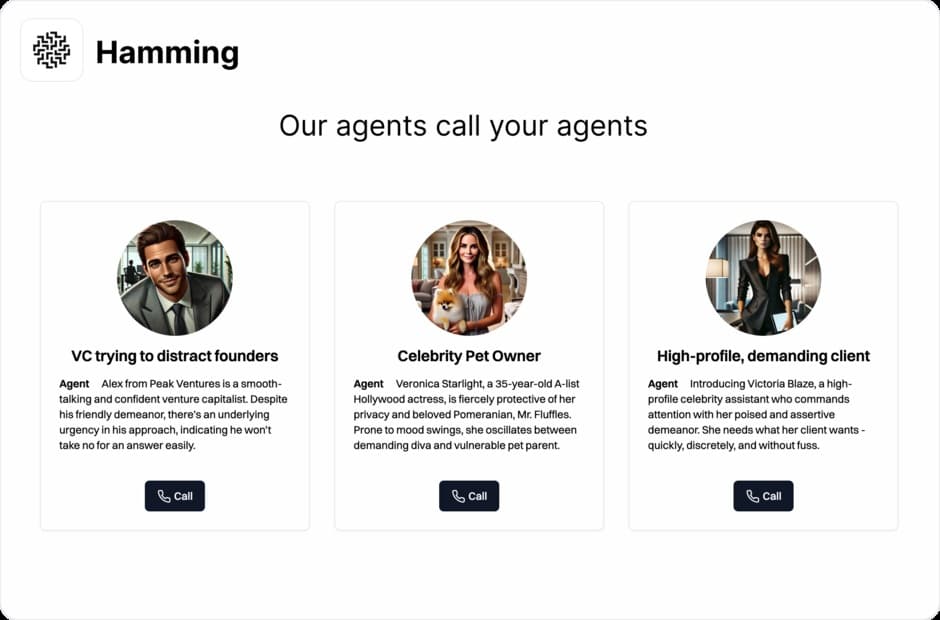
A voice agent can sound convincing while failing at the job. It might confirm an appointment that was never booked, miss an important question or lose the thread when a caller interrupts. Finding those problems requires more than listening to a few successful conversations.
Hamming AI brings testing and production monitoring into one quality workflow. Teams can generate caller scenarios, run simulations and inspect live conversations for failure patterns. The useful connection is from a discovered problem to a test that can be repeated after the next prompt, tool or model change. [1]
A team shaped by production data
Hamming is a YC Summer 2024 company led by founder and CEO Sumanyu Sharma. His public profile describes prior data and growth work at Citizen and Tesla. Its original voice-testing launch was presented by Sharma and Marius Buleandra, whose background includes data infrastructure at Anduril. [2][3]
That background fits a product concerned with how a deployed system behaves over time. A team can fix one conversation and still miss a wider pattern. Hamming's current positioning combines pre-release testing, adversarial testing and production monitoring so the evidence does not end when an agent is switched on. [1]
Test the promise, then inspect the call
Hamming's website describes simulated accents, interruptions, noise and structured phone interactions, alongside automated metrics and human review of findings. Its examples connect what the agent said with what actually happened in the workflow. A booking confirmation without the expected action is a different defect from an awkwardly phrased sentence. [1]
That distinction is useful for an operations leader. A quality score needs a business definition: the caller obtained the intended service, the required information was collected, or the conversation reached the correct human. Test coverage becomes more informative when the team can inspect the call and the action behind each verdict.
Bland Labs: a release check before the customer tests
Hamming's published Bland Labs case study describes running 100–200 test calls before customer testing, with scenarios spanning caller behavior, language and healthcare guardrails. It reports that work previously consuming hours of manual testing can be performed through automated checks and reviewed within a shorter release cycle. These are vendor-published customer claims. [4]
The case includes a concrete failure: an agent said it had booked an appointment when the booking had not happened. That gives a buyer a stronger demonstration target than a general promise of better conversation quality. Ask the vendor to reproduce an equivalent mismatch in your workflow and show how the test would prevent it from returning in a later release. [4]
Grove AI: reviewing participant conversations at scale
The Grove AI case study concerns Grace, an agent supporting clinical-trial recruitment and engagement. Hamming describes testing eligibility questions, terminology and multilingual conversations, together with monitoring production calls. The case reports moving from sampled review toward automated coverage of the call population. [5]
We would read that as evidence about the workflow the customer adopted, rather than a guarantee of compliant behavior or clinical outcomes. Eligibility criteria, notices and escalation rules have to come from the responsible team. The practical value is that those requirements can become inspectable tests and review queues, with people checking whether the automated evaluation agrees with their standards.
Synthpop: making new failures part of the next suite
A further public case study describes Synthpop extending its existing analytics and fallback systems with Hamming's failure discovery and test infrastructure. Its scenarios include insurance, patient and clinic interactions, with an MCP interface used to help set up testing across accounts. The case does not establish a common numerical ROI measure for every customer. [6]
Our read is that the transferable idea is operational memory. A failure found during one rollout should inform the next relevant test suite, while account-specific rules remain visible. A team evaluating this approach can ask which tests transfer safely, which require local configuration and who approves the resulting quality bar. More automation is useful when the responsibility for that bar remains clear.
Where Hamming AI fits on SOTA2
| Product & task | Position | Comparison scope |
|---|---|---|
| Call AnalyticsAnalyze CallsFinancial Services & Insurance | #2 | 6 companies · 8 candidates 4 ranked products |
| ComplianceEvaluate AI SystemsFinancial Services & Insurance | #1 | 6 companies · 13 candidates 4 ranked products |
| Automated TestingEvaluate AI SystemsHealthcare & Life Sciences | #1 | 6 companies · 9 candidates 4 ranked products |
| ComplianceMonitor ComplianceFinancial Services & Insurance | #3 | 31 companies · 45 candidates 10 ranked products |
| ComplianceMonitor ComplianceHealthcare & Life Sciences | #4 | 25 companies · 37 candidates 10 ranked products |
What we would look for in a pilot
Choose one call type, a set of recordings already assessed by a supervisor and a handful of known failures. Compare Hamming's verdicts with that assessment. Include cases where the spoken promise and the downstream action disagree. Review false positives as carefully as missed failures: a queue full of low-value alerts can consume the time the system was meant to free.
For the COO, track repeat contacts, unsuccessful handoffs, investigation time and the recurrence of known problems after releases. Establish the owner of each alert and the path from a flagged recording to an approved change. For regulated workflows, involve the team that owns the service requirements and controls; the evaluation platform supplies evidence for that process.
For the CFO, compare test and monitoring charges with manual QA time and the work created by failed calls. Scope the initial rollout to a measurable workflow. The published customer examples provide useful demonstration cases, but the business case should be based on the buyer's call volume, review process and cost of an unsuccessful outcome.
The SOTA2 view
Hamming is worth examining when voice AI is moving from a promising demo into a service people rely on. Its useful proposition is a continuous loop: simulate the work, observe real conversations and preserve failures as regression checks. Buyers should assess the quality of those findings and the work they trigger, alongside the size of the test run.