
A mortgage file can wait for several different reasons: a missing document, a condition that needs review or a borrower who has not reached the right person. Those queues belong to different teams, but the borrower experiences one process. Making one step faster does not necessarily move the loan forward.
Sei AI organizes its current platform, UMOS, around the work across origination and servicing. It describes agents for borrower conversations, document intake, conditions, quality control and call compliance, connected to existing loan systems. The operational proposition is to coordinate the steps between a request and a completed, reviewable record. [1]
The people and the mortgage focus
Sei's public YC profile lists Pranay Shetty and Ramkumar Venkataraman and the Winter 2022 batch. Shetty's background includes finance and operating work; Venkataraman's includes payments and large-scale systems at PayPal, Wise and Amazon. [2]
The public mortgage launch describes helping lenders and servicers lower the work involved in origination and servicing. The current website is more specific about the individual queues the platform targets. That evolution is useful to a buyer: a product demonstration should name the exact desk being evaluated, its inputs and the decisions that remain with staff. [1][3]
A shared record across specialized desks
UMOS is presented as a collection of specialized agents operating against a common rulebook and loan context. The site describes collecting documents, organizing records, checking conditions and routing uncertain work for human attention. A borrower-facing conversation is therefore only one part of the system. [1]
For an operating team, the important connection is between the conversation and the record it changes. An agent should not merely say a document is missing; the process needs to identify the right file, request the appropriate material and leave a trace another reviewer can follow. Buyers can evaluate each handoff without assuming every advertised desk must be deployed together.
Better Mortgage: quality control by exception
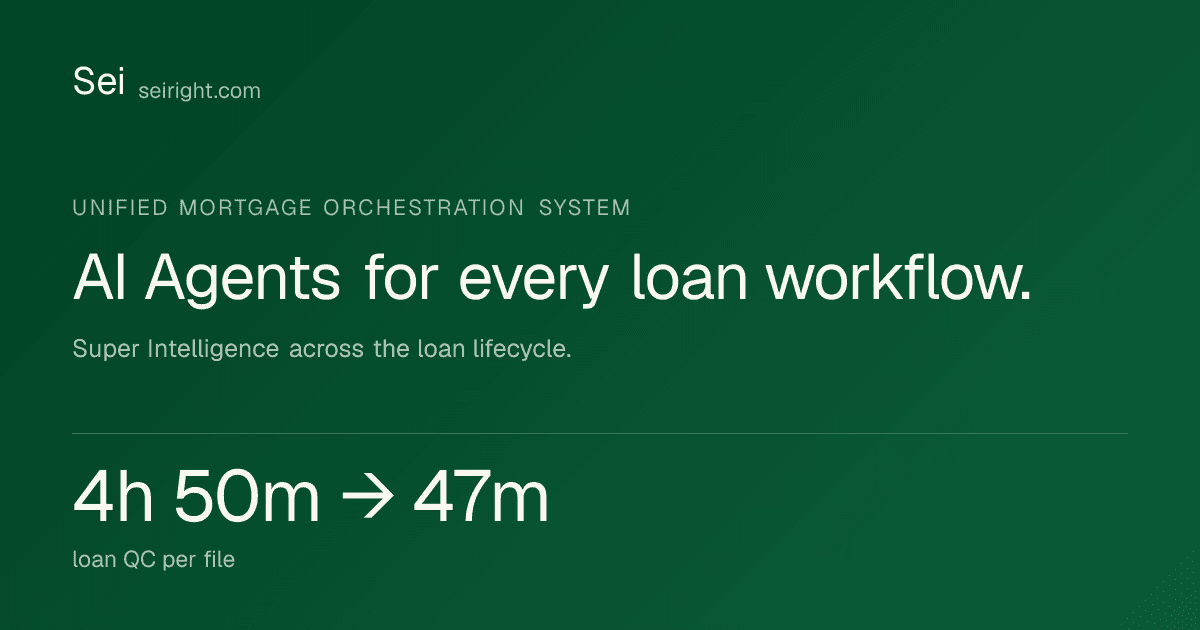
In a published Better Mortgage case study, Sei reports reducing human loan-file review from four hours fifty minutes to forty-seven minutes. It describes checking more than twenty document types against agency guidelines and investor overlays, with source citations and confidence-based exception routing. Those figures are the customer results as reported by Sei, not an independent SOTA2 audit. [4]
The operating change is more informative than the percentage alone. Reviewers move from reading every line toward examining uncertain or problematic items. To evaluate the same approach, a lender would need to compare what clears automatically with an agreed reference review and understand which exceptions account for the remaining work. The rules and the evidence trail matter as much as elapsed time.
Better Mortgage: from call sampling to a full review queue
Another public case study describes loan-officer call quality assurance at Better Mortgage. Sei says it encoded the lender's procedures and scored calls against them, reporting more than a thousand calls audited monthly and a cleared backlog. The case describes cited moments, scorecards and recurring gaps that can guide coaching. [5]
This is relevant to a compliance operations team because a recording can be checked against a consistent rulebook while reviewers investigate the findings. Automated coverage does not itself establish that every decision or conversation complies with every requirement. We would ask who maintains the rules, how disagreements are resolved and how a change in policy is tested before it affects scores.
Scheduling a borrower conversation
In a published case study of an unnamed top-25 California independent mortgage bank, Sei describes inbound and outbound voice agents linked to the lender's CRM and calendars. It reports 9.2 times as many appointments and a 12% lift in lead-to-funded conversion against that customer's prior baseline. [6]
A buyer can still extract a concrete scenario: a new inquiry arrives, the agent performs the approved intake and an appointment is written to the right calendar. The lender supplies the communication rules and handles questions outside that scope. The useful test is whether the appointment exists, the record is complete and the loan officer receives enough context to continue.
Where Sei AI fits on SOTA2
| Product & task | Position | Comparison scope |
|---|---|---|
| Call Monitoring & ComplianceAnalyze CallsFinancial Services & Insurance | #3 | 6 companies · 8 candidates 4 ranked products |
| Voice AgentsAnswer Phone CallsFinancial Services & Insurance | #4 | 6 companies · 6 candidates 5 ranked products |
| Fincrime ReviewsInvestigate CasesFinancial Services & Insurance | #7 | 17 companies · 25 candidates 10 ranked products |
| Call Monitoring & ComplianceMonitor ComplianceFinancial Services & Insurance | #8 | 31 companies · 45 candidates 10 ranked products |
What we would look for in a pilot
We would start with one desk and historical loan files or recordings for which the team has an established assessment. Compare the platform's findings with that baseline, including incomplete documents, conflicting evidence and exceptions. Require a reviewer to trace an answer back to the document, conversation and rule that produced it.
For the COO, measure queue age, manual touches, re-opened work and the time spent resolving exceptions. Follow the handoff into the loan system rather than stopping at a generated answer. Agree on who owns an uncertain case and what happens when an integration or document source is unavailable.
For the CFO, build the case around the cost per completed file or reviewed interaction, including deployment, review effort and service fees. Keep the measures for borrower contact, document review and call QA separate so an improvement in one queue is not counted several times. Published outcomes can guide the pilot design; they should not become a forecast for a different lender without its own evidence.
The SOTA2 view
Sei is relevant to mortgage organizations where the burden sits in the coordination between borrower communications, documents and review queues. Its public customer cases make that work concrete. We would evaluate it desk by desk, looking for fewer unresolved handoffs and a record the responsible staff can examine, rather than treating a broad automation claim as the buying decision.