
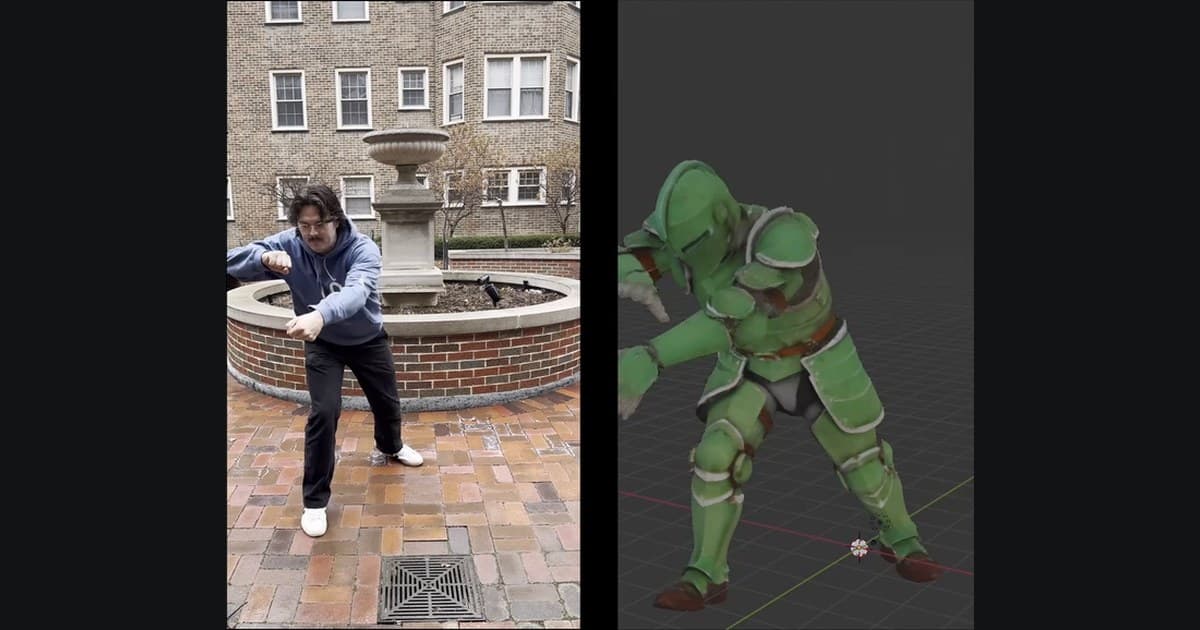
One camera, one movement
A studio needs a celebration for its lead character. An animator can film a colleague doing the move, with their full body and feet in frame, and upload the continuous shot to Uthana. The tool accepts clips from two seconds to one minute. [1][2][6]
Uthana estimates the performance from the footage and returns an editable skeletal animation. The animator can adapt it to the studio’s own character, trim it or blend it into an existing idle animation, then export it for the game engine. [1][3][6] A ten-second output at the Video-to-Motion 3.0 rate of $0.06 per second costs $0.60. [7]
When a gesture needs its fingers
Fine hand motion and planted feet are hard to recover from ordinary video. Uthana’s Video-to-Motion 3.0 refines wrist and finger movement and reduces foot sliding. The company demonstrates the hand work with an American Sign Language gesture. [1][2][6]
The same capture, another body
Robotics teams can export frame-by-frame joint rotations for the Unitree G1 as reference motion for training and simulation. A robotics team can also start with captured motion from Uthana’s library. [4][6]
Two brothers from games and product
Viren and Kethan Tellis founded Uthana in 2023, and the company joined a16z speedrun’s first cohort. Kethan worked on animation and gameplay for Call of Duty and later Meta’s Horizon Worlds. Viren had led product at an advertising marketplace before starting Uthana. [5][6]
The bigger picture
The useful part of a filmed performance is the movement an animator can keep working with. Uthana turns one camera shot into a motion clip a team can adapt to its own character and production workflow. [1][3]
Written by SOTA2 from Uthana’s public materials and information supplied by its founder.
Sources
- Uthana · Video-to-Motion
- Uthana docs · Video to motion 3.0
- Uthana docs · Retarget to any character
- Uthana docs · Unitree G1 export
- a16z speedrun · Uthana
- Uthana founder input · Product workflow and launch
- Uthana · Video-to-Motion 3.0 pricing