
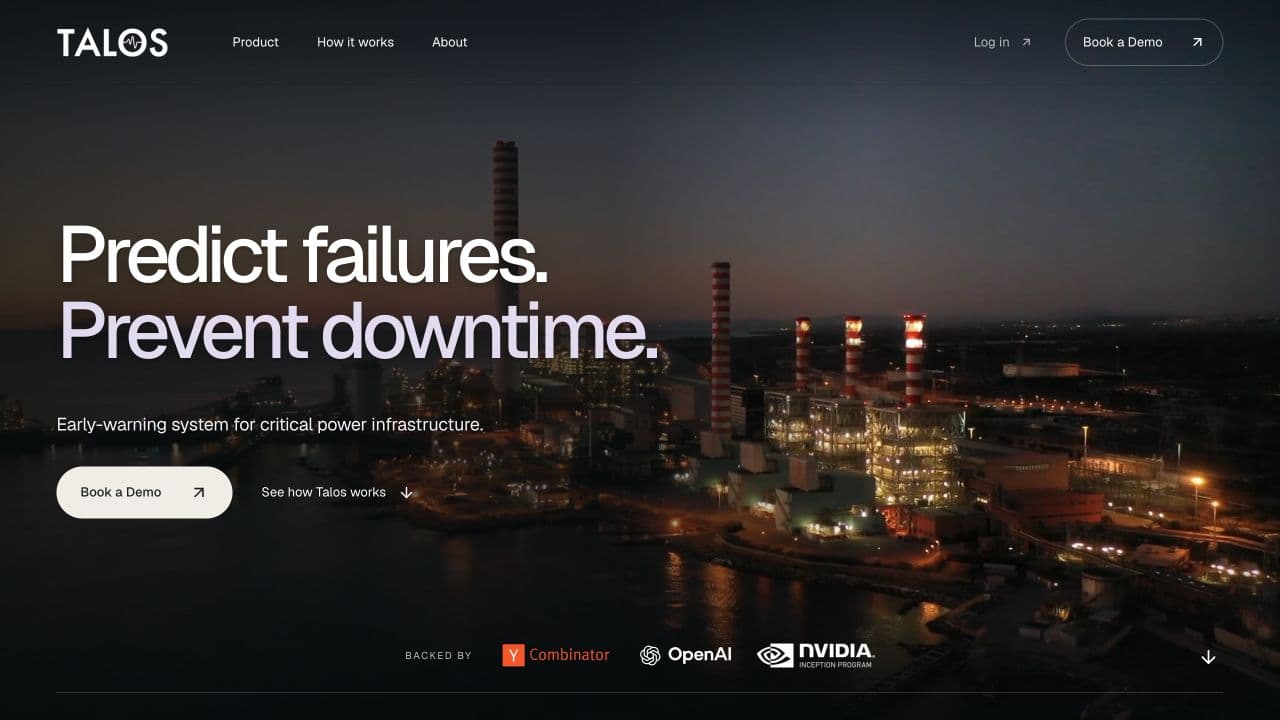
A maintenance team does not need another alarm that merely says a machine is behaving differently. It needs enough context to decide where to investigate, whether the change is unusual for that asset and what work should happen next. For critical power equipment, that decision connects reliability with the cost and timing of an intervention.
Talos is building an early-warning system around retrofit sensors and equipment analytics. Its public YC profile focuses on identifying developing problems in power infrastructure, including transformers. The intended user is the team responsible for understanding equipment condition before a failure forces the next decision. [1]
Power and software experience in the founding team
Talos joined YC’s Fall 2026 batch. CEO Amitav Kohli and COO Himani Musku studied at Carnegie Mellon; CTO Kevin Hwang studied computer science at Johns Hopkins. The public company description connects Kohli’s experience with power-sector predictive maintenance to the problem the team is addressing. [1]
That combination matters because a useful signal has to reach an operational decision. A model that detects an unusual pattern still needs to fit the asset, the maintenance process and the person who can investigate it. The product is most understandable when viewed as part of that work.
Attach a sensor, learn the machine, flag a change
Talos describes magnet-mounted devices that attach to existing equipment. The sensors monitor signals including vibration, magnetic or electromagnetic behavior, temperature, humidity and motion. Its published workflow establishes a baseline for each machine, then alerts the team when behavior changes. [2]
The company’s Talos Dash preview brings together an equipment view, frequency analysis and an assistant. These are public product demonstrations. They show how the company intends to make sensor information accessible, without establishing that a particular fault was predicted at a customer site. [2]
Investigate an asset before scheduling an intervention
Consider a transformer whose behavior changes while it remains in service. A machine-specific baseline gives the maintenance team a reference for asking whether the current signal differs from that asset’s usual operation. Talos’s documented alert workflow points the team toward what changed and where to investigate. [2]
The next step belongs in the maintenance process: compare the alert with operating conditions, inspect the equipment and decide whether additional testing or planned work is justified. This is an illustrative workflow based on the product description, not a reported Talos customer result.
The same approach can inform prioritization across monitored assets. A team needs to decide which changes require attention first and which can be observed further. The useful output is an investigation that leads to an appropriate action, with enough history to explain the decision afterward.
Make the signal useful to the people on call
For an operations manager, the practical issue is whether a new monitoring layer reduces uncertainty or creates another queue of alerts. The installation may be simple, but the team still needs an owner for notifications, a method for recording an investigation and a way to relate findings to the equipment’s maintenance history.
That also shapes how the economics should be assessed. A detected anomaly is an intermediate result. The business outcome depends on whether it helps the organization plan useful work, avoid an unnecessary intervention or respond to a developing problem with better information.
Where Talos fits on SOTA2
A ranked comparison is not yet available for Talos.
What we would look for in a pilot
We would start with a limited set of assets whose operating history is understood. Compare the baseline and alerts with the maintenance team’s observations through different loads and conditions. Record false alarms, missed changes and the time required to investigate each notification.
Agree on what action would make the pilot worthwhile before it starts. Evaluate sensor placement, data continuity and the quality of the explanation alongside any detected issue. Claims about avoided downtime need an operational record that supports the connection.
The SOTA2 view
Talos is relevant to operators seeking more continuous visibility into existing power equipment. Its proposition is a practical connection between retrofit sensing, the behavior of an individual machine and the maintenance team’s next investigation. A focused asset-level evaluation can establish whether that connection is useful in the field.