
A store employee knows which questions customers keep asking. A shift supervisor knows where the handover breaks down. A headquarters team may hear about neither until the same problem has spread across several locations. The knowledge exists, but gathering it through individual interviews can take more time than an operations or transformation team has.
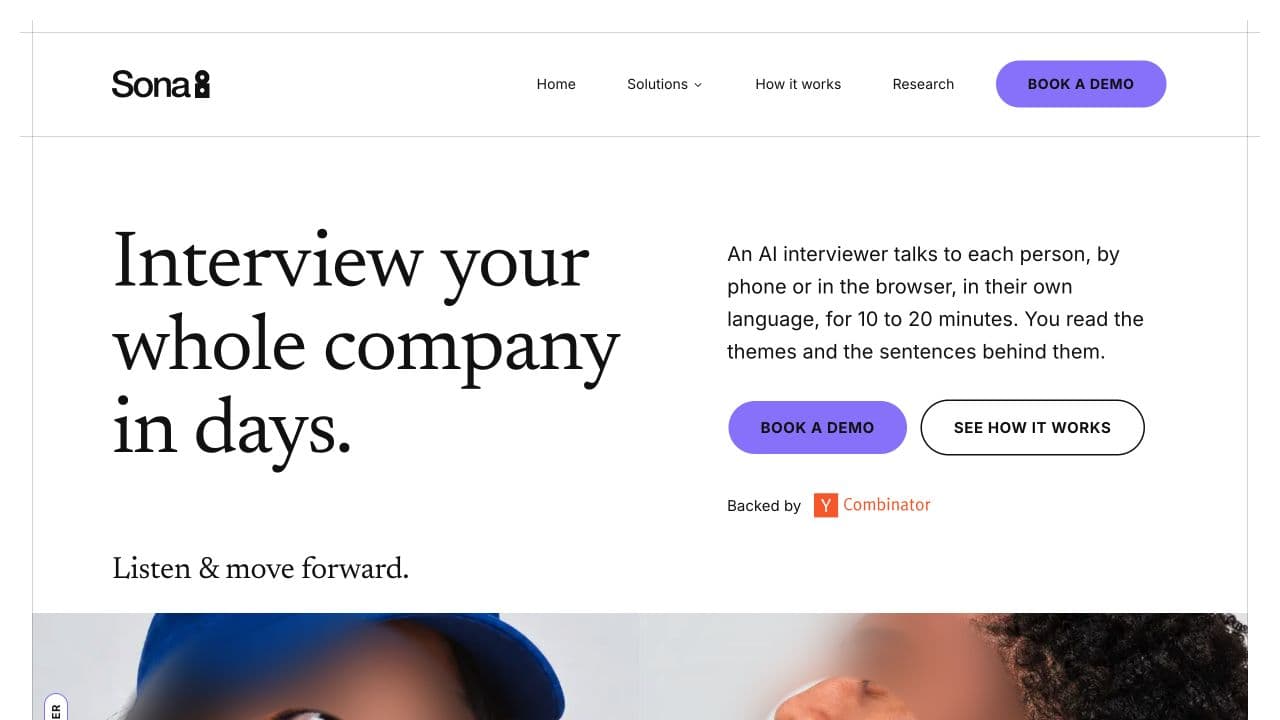
Sona8 uses AI voice agents to interview employees about their work, ask follow-up questions and organize their experiences into themes. The aim is to give leaders a wider view of what people are encountering, with the underlying statements available alongside the summary. It is designed for hearing how work happens across an organization. [1]
A team familiar with the interview bottleneck
Sona8 joined YC’s Fall 2026 batch. Co-founders Anton Hantel and Thilo Tamme previously worked at BCG and BCG X; CTO Madeleine Malmsten brings experience from McKinsey QuantumBlack. Their public launch describes a familiar consulting problem: interviewing a few dozen people, translating conversations and producing a deck still left gaps between written processes and lived experience. [2]
That background helps explain the product’s focus. The useful output for a transformation team is a better understanding of a process and the people involved in it. Interview volume matters when it brings previously unheard sites or departments into that picture, rather than simply producing more transcripts to read.
From one question to comparable experiences
A project begins with a question and supporting documents. Sona8 describes reading that context before the interviews, then speaking with employees by phone or browser in their own language. Its published workflow uses conversations of about 10 to 20 minutes, with follow-up questions based on what a person says. Participants can also show a process through optional screen or camera sharing. [3]
Answers are organized into themes with counts and the statements behind them. Teams can compare what different sites or departments report and ask questions of the results through connected AI assistants. After making a change, they can ask again. The public walkthrough labels its example interview and numerical results as illustrative, so those examples should be read as explanations of the workflow. [3]
For an operating leader, that creates a useful path from an employee’s account to a question worth investigating. A recurring complaint can be examined across locations; an unusual account can remain visible as a local issue. Interpretation and the decision about what to change still belong with the team running the project.
Retail: learning across many stores
Founder Anton Hantel supplied retail as a concrete scenario for this article. Store employees know what customers request, why people leave without buying and which internal processes make service harder. Sona8 can interview employees across a store network and bring together experiences that are shared, those that are specific to a location and practices other stores could learn from. [5]
Consider a retailer investigating repeated lost sales. The project can start by asking employees about recent interactions, then use follow-ups to distinguish unavailable products, unclear policies and slow internal handoffs. Comparing those accounts gives headquarters a more specific starting point than a single satisfaction score. This is an illustrative application of the founder’s scenario, not a reported sales result.
Hantel says Sona8 is working with a major European retailer employing more than 5,000 people, as well as a top-three consulting firm and its clients. The public YC description also reports more than 10,000 employee interviews. These are company-reported adoption indicators; they do not establish a particular financial outcome for the retail scenario. [2][5]
Finding the workarounds between formal processes
Sona8’s operational-excellence page focuses on near misses, stalled information or material flows, and fixes employees have already invented locally. It describes returning themes, process maps showing handoffs and rework, and ideas organized by value and effort. The company reports one unnamed four-plant project that led to safety measures and operational improvements; the page separately marks its shift-by-shift visualization as an example. [4]
The operational value of this approach is in locating a specific handoff or workaround that a team can investigate. An interview may reveal why a documented approval process is rarely used, or why one shift repeatedly solves the same problem differently. That evidence can help a process owner choose where to observe the work directly and which change to test first.
Repeated interviews can then provide another view of implementation: do employees describe the new process, and does it address the original friction? That is useful feedback on adoption. Any claim about productivity, safety or revenue should still be supported by the organization’s operational measures.
Where Sona8 fits on SOTA2
A ranked comparison is not yet available for Sona8.
What we would look for in a pilot
We would start with one operational question and include employees from different sites, roles and shifts. Agree on how participation, attribution and access to statements will work before inviting people. Compare the resulting themes with a small set of human interviews and direct observation, paying attention to minority views as well as the most frequent answers.
The next step should be a concrete decision: a process to examine, a change to test or a question that needs more evidence. Assign an owner and use a follow-up round to check what employees experienced after the change. Measure interview effort and the usefulness of the findings alongside any operational outcome, rather than treating the number of interviews as the result.
The SOTA2 view
Sona8 is relevant to leaders who need a clearer account of work spread across many people and locations. Its strongest idea is connecting broad participation with follow-up questions and inspectable employee statements. The useful test is whether that evidence helps a team choose and follow through on a specific improvement.
Sources
- Sona8 — employee listening overview
- Y Combinator — Sona8 company, founders and public launch
- Sona8 — how interviews and themes work
- Sona8 — operational excellence scenarios
- Sona8 — retail use case and current company context supplied for this article by founder Anton Hantel