
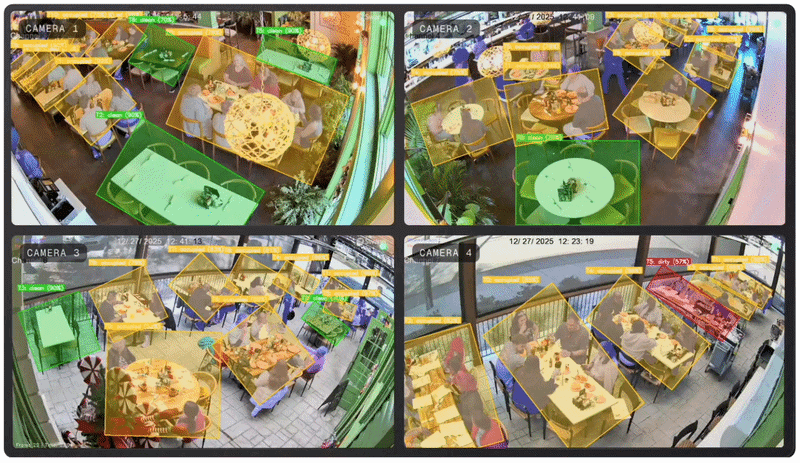
A party sits down. Another table is waiting to pay. Across the room, plates have been cleared but nobody has reset the table. [2]
The point-of-sale system knows what was entered. A floor manager also needs to know what is happening between those entries. [2]
Shire uses the restaurant’s existing cameras to follow that work.
It is an AI floor manager for full-service restaurants. Shire tracks table activity, alerts staff and helps hosts seat the next party with a server who has room. [2]
The shift becomes something the team can respond to as it unfolds. [1]
The dining room as a live operating picture
Shire’s host system updates table states from camera footage. It helps balance covers across servers and avoid double-seating. [1]
Live coordination sends tasks to hosts, servers and bussers. A table ready to order needs a server. A table ready to reset needs a busser. The task goes to the role handling it. [1]
The operations assistant brings visual activity together with POS, reservation and staffing data. Managers can examine what is slowing service and plan for upcoming shifts. [1]
Camera observations add the dining-room activity that a transaction record alone cannot capture. [2]
Restaurant experience behind the floor manager
Cameron Kuperman and Alex Tabaku both worked in restaurants before founding Shire. Their experience includes the practical work of keeping service moving. [2]
Co-founder Harshith Guduru brings software engineering and machine-learning research experience. Kuperman studied math, electrical and computer engineering, and computer science at Duke; Tabaku studied mechanical engineering and math at Clemson. [2]
They founded Shire in 2026 and joined Y Combinator’s Fall 2026 batch. The company is based in Myrtle Beach, South Carolina. [2]
A busy dinner service, seen table by table
Here’s how a full-service restaurant would use Shire.
The host checks which tables are occupied, ready for clearing or available for the next party. Shire uses that live state when balancing the next seating across sections. [1][2]
During service, the team receives prompts for tables needing attention. The manager can see the floor and direct staff where they are needed. [1]
After the shift, the manager can compare table turns and staffing with the activity observed in the room. That record supports the next schedule and service plan. [1][2]
Keep the current POS, or bring the operation together
Shire Intelligence adds floor intelligence alongside an existing point-of-sale system. Shire POS combines it with payments, reservations and broader restaurant operations. [1]
Shire Enterprise adds onboarding, analytics and support for multi-location groups. The product direction brings the room’s activity and the restaurant’s business systems into the same operation. [1]
Where Shire ranks
Current rankings. Positions come from public evidence, and no company can pay for a place. How we rank
The bigger picture
A restaurant’s next decision often starts with something happening on the floor. [2]
Shire gives staff a live picture from cameras the restaurant already has. [1]
Run the shift with a clearer view of the room.
Written by SOTA2 from Shire’s public materials. Customer experiences and product plans are reported by Shire. Ranking analysis and comparison data are from SOTA2.