
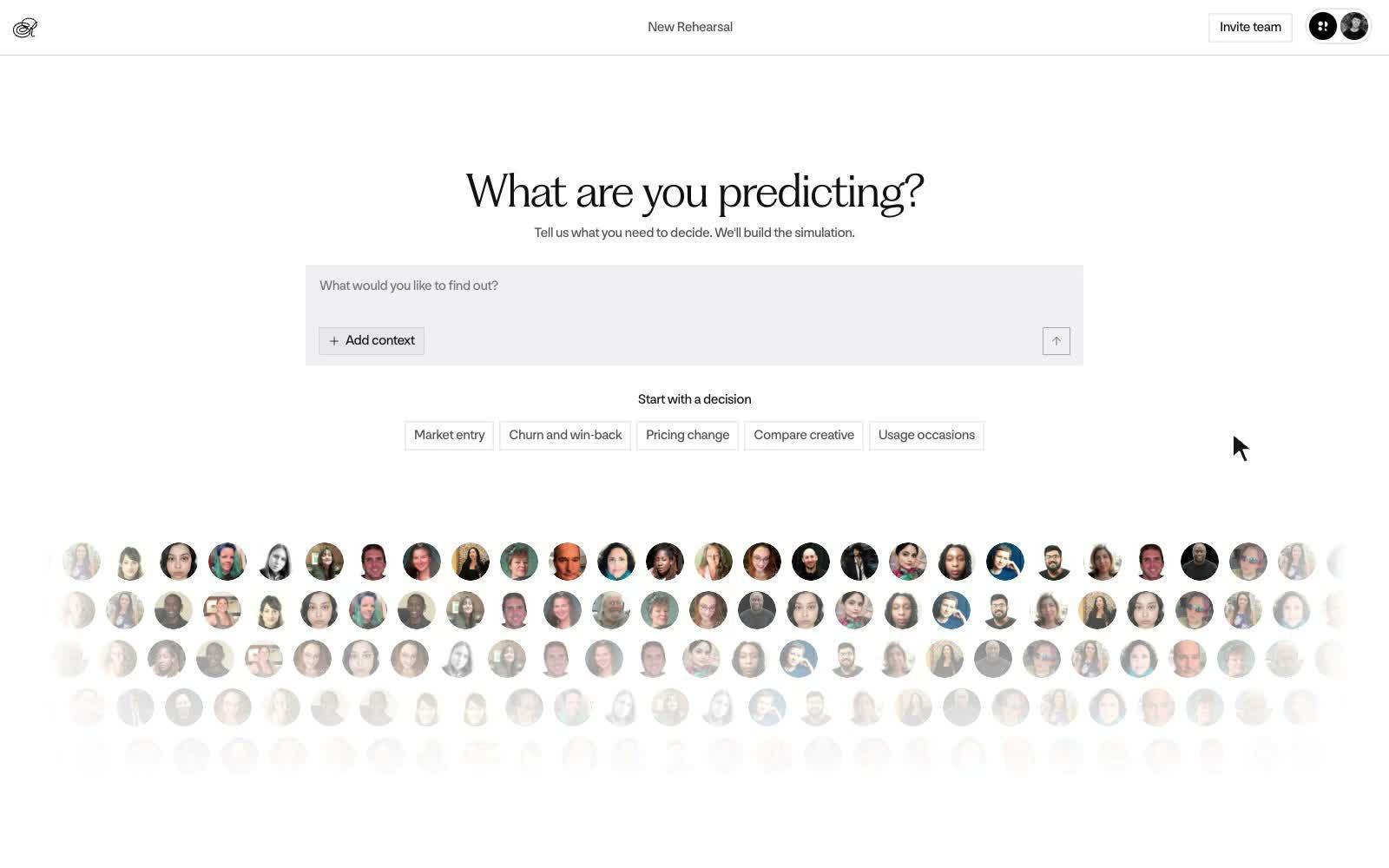
Start with the decision
A team choosing between two product concepts has to work out whose preferences matter and what to ask. The choice gets expensive once it turns into a launch, a pricing change or a campaign. [1]
Rehearsals gives the team a place to try that decision before committing. The researcher enters the choice, narrows the audience and decides what outcome to measure. Rehearsals simulates individual answers and shows how the responses are distributed. [1][2]
Build the simulation from real people
Rehearsals recruits and interviews its own panel. It uses those interviews and survey responses to build what the team calls AI twins. The responses from a simulated audience can show how preferences vary across a group. [1][2]
A team comparing two campaign ideas could ask the same question of two audiences. If the predicted answers differ, the team has a more specific question to take into its next round of research. [1]
Measure the difference between a prediction and an answer
Rehearsals built Human Behavior Bench in collaboration with Google DeepMind and Kaggle. Its first version uses responses from 1,244 U.S. adults and covers 1,199 evaluation tasks. [2]
Each task gives a model a question and an audience. The model predicts how that group will answer, and the benchmark compares its distribution with the answers people actually gave. Google DeepMind and Kaggle helped design the benchmark and evaluate base models. Kaggle hosts the public leaderboard. [2]
The team behind the panel
Liam Bolling, David Schmetterling and Daniel Katz co-founded Rehearsals. Bolling worked on the Gemini API and Project Mariner. Schmetterling led computer vision work at Wayfair and had known Bolling since middle school. Rehearsals joined a16z speedrun’s fourth cohort. [3][4]
Where Rehearsals ranks
The bigger picture
A simulation can give a team a better question to ask. Human Behavior Bench gives the team a way to see how closely those predictions track the answers from real people. [2]
Written by SOTA2 from Rehearsals’s public materials.