
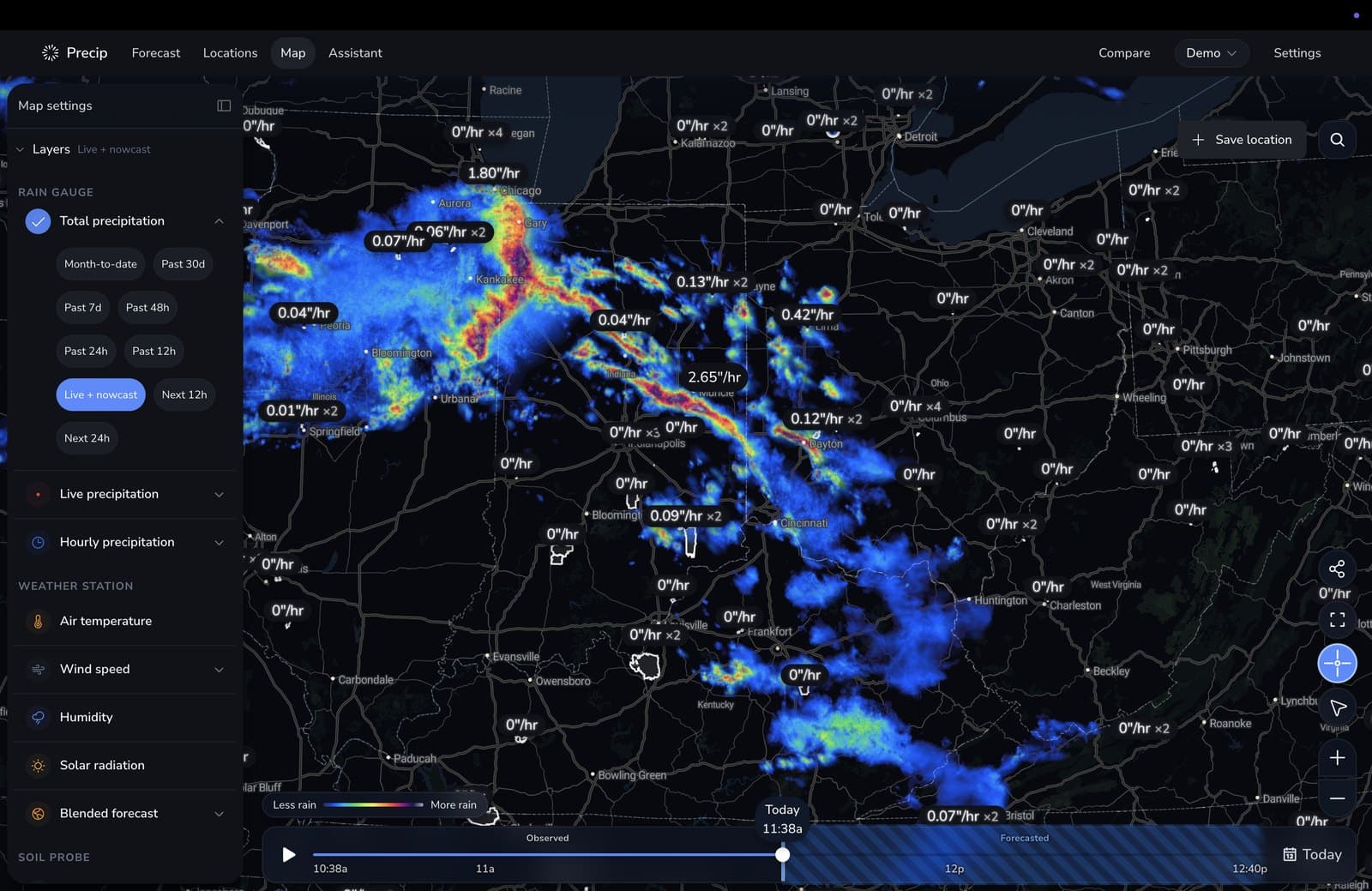
The morning plan can change after an overnight storm. One job site is soaked, another barely caught any rain, and the crew needs to know where to go first. A forecast for the nearest town leaves someone making phone calls to fill in the picture.
Precip gives that conversation a more useful starting point: a weather record for the locations where the work happens. It uses radar, gauge data and machine learning to estimate precipitation that has already fallen, alongside forecasts for what comes next. A manager can return to the same site after a storm and inspect the record. [1]
A weather problem the founders met in farming
Founded in 2023 and part of Y Combinator’s Winter 2024 batch, Precip is led by Jesse Vollmar, CEO, and Michael Asher, CTO. Vollmar previously led FarmLogs, a YC Winter 2012 company. Asher brings a background in data science and software engineering. [2]
Their founding story traces Precip to work at FarmLogs, where rainfall tracking became a feature people kept returning to. Vollmar describes non-farming businesses signing up to see weather history for their own operations. The founding team also included product designer Sam Pierce Lolla. It is a practical origin for a product built around the difference between a weather forecast and the conditions people have to work with. [3] [4]
One weather record, several ways to use it
Precip’s current product spans a mobile and web app, professional tools for teams, and a developer API. Each offers a different way to put location-specific weather into a daily decision:
The distinction between history and prediction matters here. Precip’s past rainfall totals are estimates built from observations; its next-hour nowcast predicts where rain is going. The company describes roughly one-kilometer precipitation data in the US, while resolution and coverage vary by region. [1] [5]
Where the record becomes useful
Giving a crew’s morning plan a shared starting point
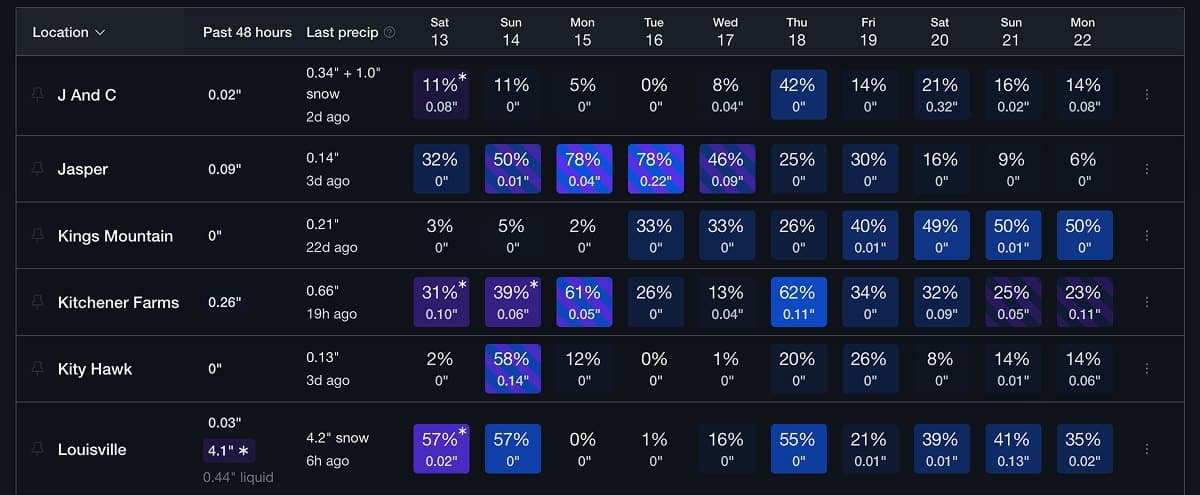
For a business managing several sites, Precip’s locations view puts recent precipitation and upcoming forecasts alongside one another. Sites can be grouped by crew, region or customer, and alerts can be routed to the people responsible when a chosen threshold is crossed. [6]
That gives an operations manager a repeatable starting point for the morning conversation. Which sites need a closer look? Where did conditions change overnight? The product can organize those questions before a supervisor makes the call on access, equipment or the day’s work.
Reading the field alongside the forecast
Precip’s farming guide connects rainfall history with root-zone soil moisture, soil temperature and ponding. A grower can compare saved fields and see when the last rain event ended, rather than assuming each field experienced the same storm. [7]
The longer view can be useful too. Precip’s published chart guide shows comparisons between locations, across years and against long-term precipitation normals. That lets a team put a wet week into the context of the season it is managing. [8]
Bringing weather into software growers already use
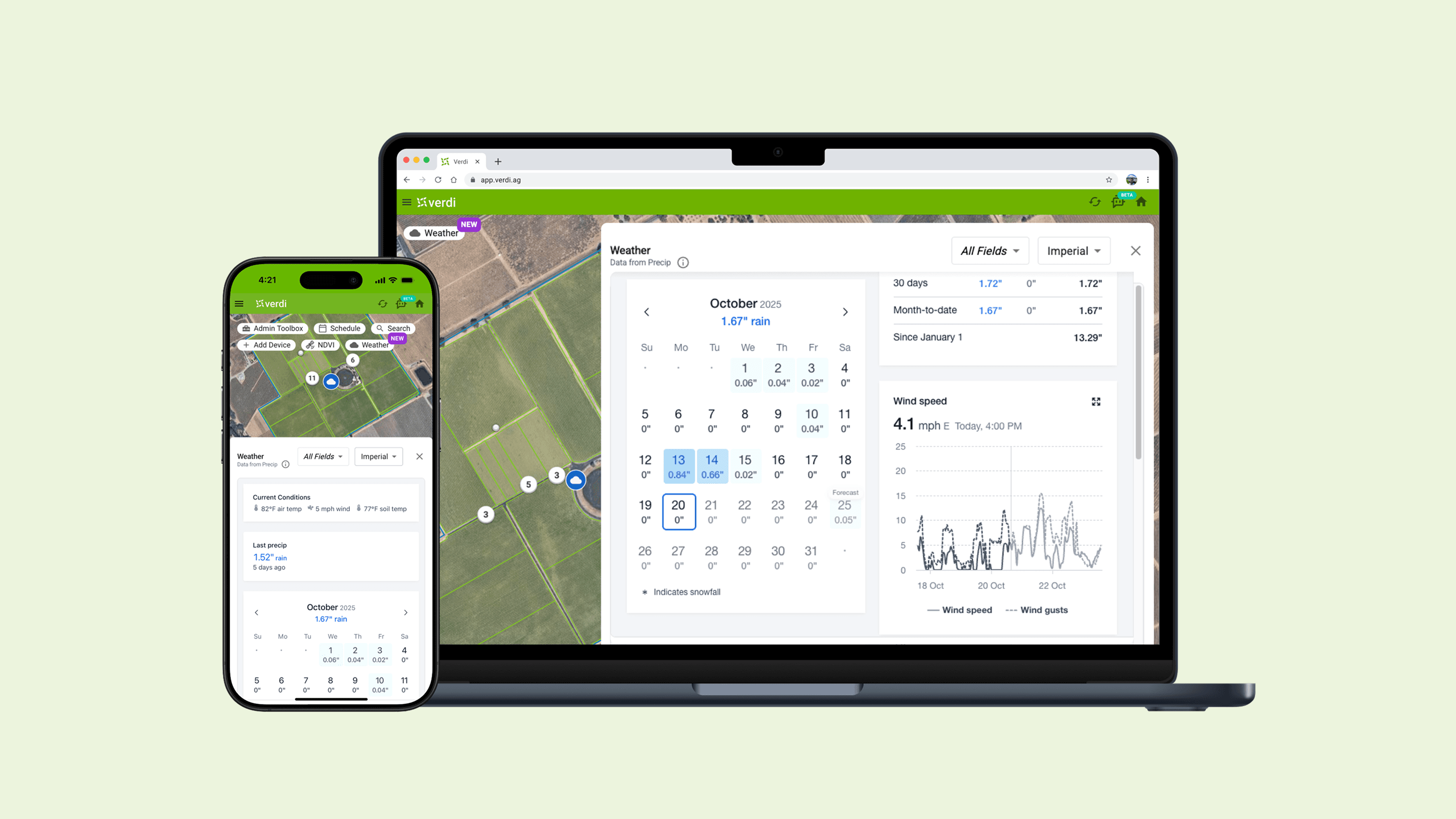
Precip’s Verdi customer story offers a concrete integration example. Verdi brought weather history and conditions into its farming dashboard, where growers make irrigation decisions. The published account describes an embedded weather page with location, units, theme and widget controls, so Verdi’s team could deliver the experience without building its own weather interface.
The useful part for a software buyer is the placement: weather appears alongside the field and the decision. The case gives a recognizable alternative to asking people to consult another app, while leaving the customer’s product team in charge of the wider workflow. [9]
Where Precip stands on SOTA2
The Precip app ranks first in SOTA2’s Monitor Environmental Conditions comparison for Climate & Environment. The review considered 10 candidate products from 10 companies, with four receiving ranked positions. Its leading position reflects the direct fit between rainfall observations, location monitoring, notifications and multi-location views.
| Product & task | Position | Comparison scope |
|---|---|---|
| PrecipMonitor Environmental Conditions | #1 | 10 companies · 10 candidates 4 ranked products |
Snapshot: October 15, 2026, 05:03 UTC; checked October 17. SOTA2 uses AI review of available evidence and a weighted rubric for task fit, adoption, product detail, pricing and market fit. Precip’s own forecast benchmark is described below. View the comparison and methodology.
Reading the accuracy evidence
Precip also publishes its own next-hour forecast benchmark. It records providers’ forecasts as issued, then compares them against weather observations over specified locations and dates. Its current results include hourly rain-gauge comparisons and five-minute radar checks. Those distinctions matter: a score for detecting rain in the next hour answers a different question from the quality of a historical rainfall total. [10]
What we would look for in a pilot
For a COO, we would start with a small set of representative sites and follow a few rain events. Record how teams currently check conditions, who changes the schedule and what information reaches the field. Then ask whether a shared record reduces calls, repeated checks or disagreements about which location needs attention. Keep site inspections and operational judgment in the process.
For a CFO, we would separate the value of seeing the weather from the value of changing a decision. Compare the appropriate app or commercial API plan, integration effort and staff time against the work being evaluated. A clear baseline makes a more useful business case than assuming every avoided trip or delayed shift can be credited to the software.
The SOTA2 view
Precip is worth examining when weather creates daily coordination work across fields, job sites or customer locations. Its clearest strength is connecting what was expected, what was observed and the place a team is responsible for. That gives people a consistent record to work from, whether they use the app directly or bring the data into their own software.
This spotlight draws on public company information, product documentation, Precip’s published customer story and SOTA2’s ranking snapshot. Customer experiences and forecast benchmarks are reported by Precip; SOTA2 has not independently audited them.
Sources
- Precip — observation method, forecasts and coverage
- Y Combinator — company, leadership and batch; public Launch YC post
- Precip — founding story
- Sam Pierce Lolla — public co-founder account
- Precip — developer overview
- Precip — professional tools and published screenshots; official brand assets
- Precip — farming use cases
- Precip — historical comparison charts
- Precip — Verdi customer story
- Precip — nowcast benchmark and methodology
- SOTA2 — Monitor Environmental Conditions in Climate & Environment