
Getting an agent to work is the easy part. Keeping it working well is hard. [2]
Every model update and prompt change shifts its behavior in ways nobody catches until something downstream looks wrong. Bloated context, chatty subagents and broken tool calls sit in production traces that nobody has time to read. [2][3]
Papaya reads them.
It’s an optimization engine for AI agents. It reads your agent’s production traces and code, finds what’s hurting quality, latency and cost, and opens a pull request for each fix you approve. [1][3]
Instead of another dashboard to watch, you get fixes to review. [1]
From traces to pull requests
One line of code wraps any LLM or agent client. Traces stream to Papaya asynchronously, so nothing slows down the request path. [1]
Papaya groups every run by the job the agent is doing, so you’re looking at refund requests, not run 4812. [2]
It checks each use case against more than 200 research-backed failure patterns across context, prompts, prompt caching, subagents and tool calls. [2][3]
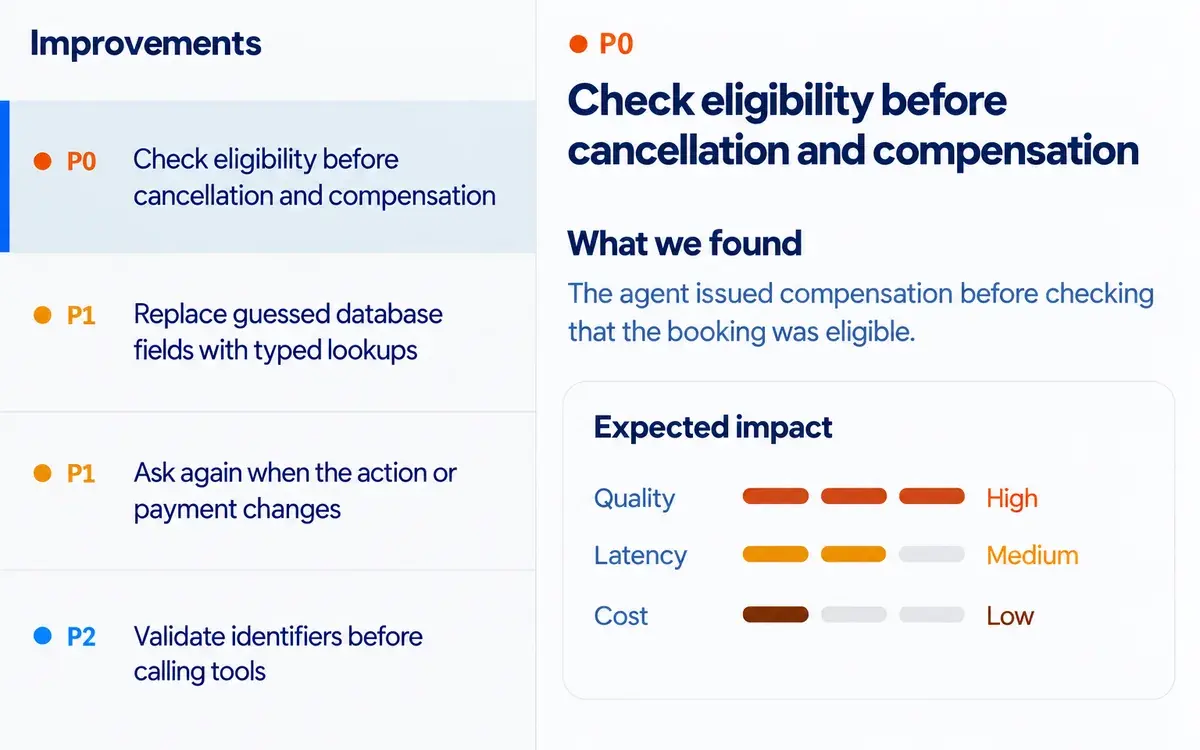
Every recommendation is ranked by its estimated effect on quality, latency and cost, and comes with the production runs behind it. Approve one, and Papaya opens the pull request; your reviewers and CI still decide what merges. [1][3][5]
Once a fix ships, Papaya keeps checking that the improvement holds. [2]
Papaya has analyzed more than 1.1 million conversations. Teams typically see a 20% gain in success rate from the first workflow analysis, about 30% lower latency and more than $25,000 a year in savings per large workflow. [1]
Built by engineers who ran agents at Amazon
Niyaz Puzhikkunnath and Faiz Vadakkumpadath each spent about ten years at Amazon. Puzhikkunnath built large-scale ML systems and agent evaluation workflows. Vadakkumpadath led teams on its enterprise data lake, at exabyte scale, after scaling Vodafone’s M-PESA mobile money system in Africa while at IBM. [3]
Macy Mody led go-to-market and operations at SafeBase from zero to $10 million in annual revenue and through its acquisition. [3]
Papaya started as an analytics agent. As a three-person team, the founders spent hours reading their own traces by hand, so they built a harness to optimize the agent. That harness became the center of every prospect conversation, and they pivoted to it. [2]
Papaya is based in San Francisco and is part of Y Combinator’s Fall 2026 batch. [3]
What this looks like in practice
Sunny Health and Hamlet
Sunny Health says Papaya’s always-on recommendations have significantly reduced the error states in its inference. At Hamlet, the recommendations and a simpler trace viewer help the team understand what its agents are doing and improve them. [1]
A context that keeps growing
Here’s how a team would use it. Papaya notices that a support agent resends the whole conversation history on every turn. It proposes summarizing earlier turns, shows the affected runs and the estimated impact, and opens a pull request when the team approves. [4]
After the change ships, Papaya checks that answer quality held while cost and latency fell. [2][4]
Where Papaya ranks
The bigger picture
Most companies shipping agents are busy building the next feature. Few have time to maintain what’s already live. [2]
Every hour spent reading traces is an hour not spent on the product. [2]
Papaya is betting that keeping an agent good should be continuous, with people approving fixes instead of hunting for them.
Your agent keeps running. Papaya keeps improving it.
Written by SOTA2 from Papaya’s public materials. Customer experiences and product plans are reported by Papaya. Ranking analysis and comparison data are from SOTA2.