
A transit plan has to work for riders and operators
A faster train can leave another rider without a connection. A more frequent bus needs a vehicle, a driver, and room in the operating budget.
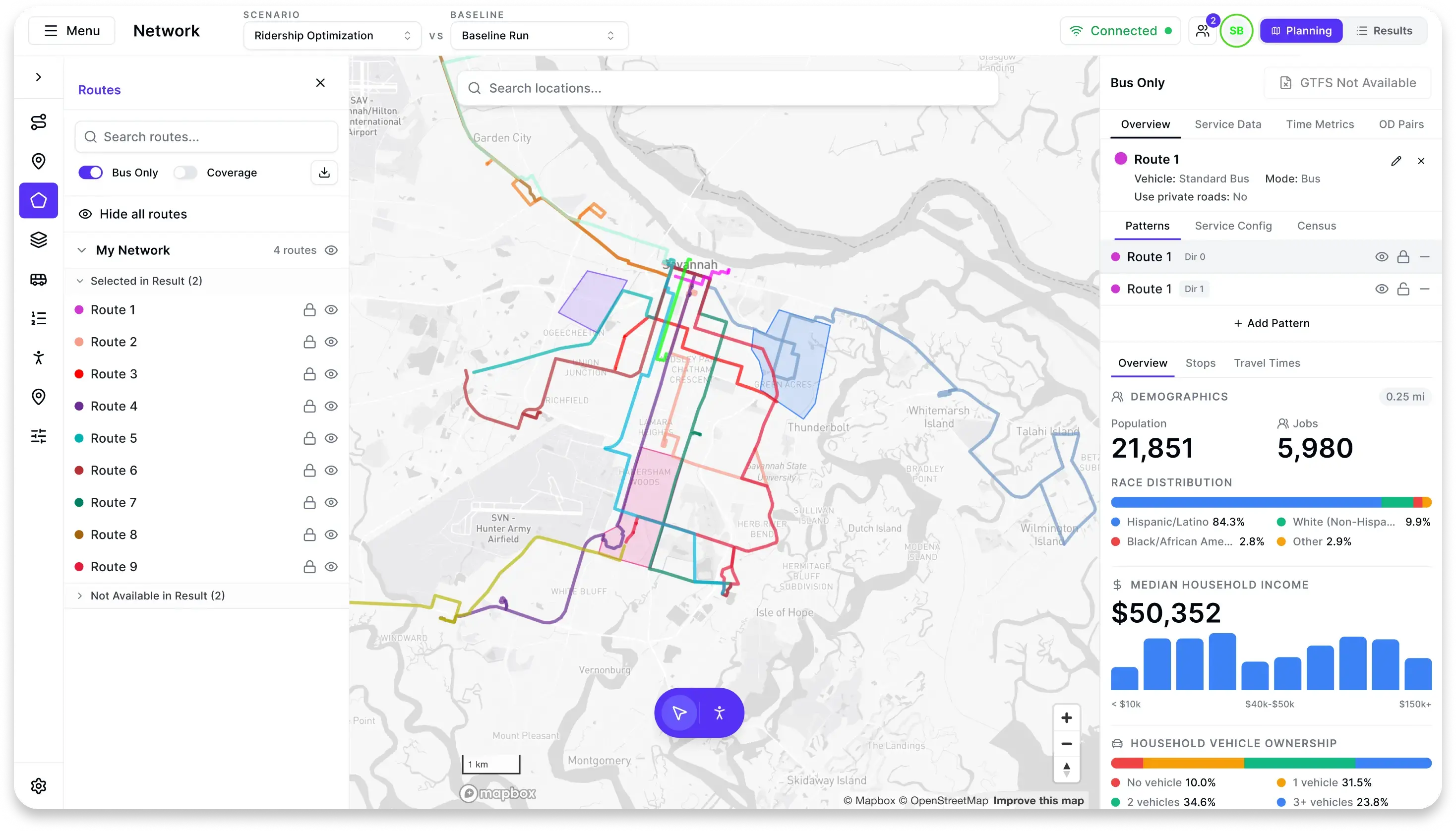
Ontra Mobility helps transit agencies work through those choices before changing service. Its planning platform models travel demand, generates service options, and compares their effects on riders and operating costs. [1][5]
The team works across fixed routes and on-demand transit. A planner can explore a revised timetable, a different bus network, or a combination of routes and microtransit zones. [1][5]
Start with the network, then change the constraints
Planners bring in their existing network and demand data. GTFS schedules and ridership provide a starting point; vehicle, fare, and origin–destination data can improve the model. [5]
They set goals and limits, including fleet size, operating cost, and access to destinations. Ontra generates options and simulates how people would travel under each design. [1][5]
That makes the tradeoffs visible. A team can compare projected ridership, journey times, cost, and equity before choosing which scenarios deserve more work. [1][5]
Scenario histories and shared workspaces keep that work available to colleagues. GTFS and GIS exports carry the chosen designs into existing planning and scheduling tools. [5]
Testing weekend service on the Long Island Rail Road
In an eight-week Transit Tech Lab proof of concept, Ontra studied weekend service on the Huntington and Ronkonkoma branches. It combined station-to-station demand with train schedules, stopping patterns, and operating constraints. [2]
Ontra estimated that a cost-neutral timetable redesign could save more than eight minutes per trip for 25% of passengers. That scenario represented roughly 177,000 passenger-hours saved annually. [2]
A separate scenario kept every existing trip and added eight express trips. Ontra estimated about 148,000 passenger-hours saved annually under that design. Both figures are modeled possibilities from the study, not measured changes to LIRR service. [2]
Comparing fixed routes and microtransit in Madera
For Madera Metro, Ontra worked with Flexlynqs and Southwest Strategies on a microtransit feasibility study. Community outreach, including a public workshop, helped inform the planning work. [3]
One modeled alternative projected 42% more riders at the same cost. Another projected 28% lower costs at the same ridership. These were separate service designs, each answering a different budget question. [3]
The proposed approach combined two fixed routes with citywide on-demand service. Modeling let the team examine how those services could complement each other. [3]
Built by researchers who helped run transit pilots
Anthony Trasatti and Connor Riley met at Georgia Tech, where they studied operations research and transit optimization. Both also worked as engineers at Google. [4]
Before founding Ontra in 2023, they helped build and manage MARTA Reach in Atlanta and CAT SMART in Savannah. Those pilots gave them experience taking an on-demand service from a model into daily operations. [4]
The company joined Y Combinator’s summer 2024 batch. Alongside planning, Ontra builds operations software and rider tools, including trip planning and service alerts. [4][5]
Where Ontra Mobility ranks
Ontra Mobility’s Planning product shares first place in SOTA2’s Automotive and Mobility comparison for Analyze Data.
The bigger picture
Ontra brings the design and operating questions into the same conversation. Agencies can test what a service change might achieve before committing vehicles, staff, and riders to it.
Written by SOTA2 from Ontra Mobility’s public materials. Case-study estimates describe modeled service options.