
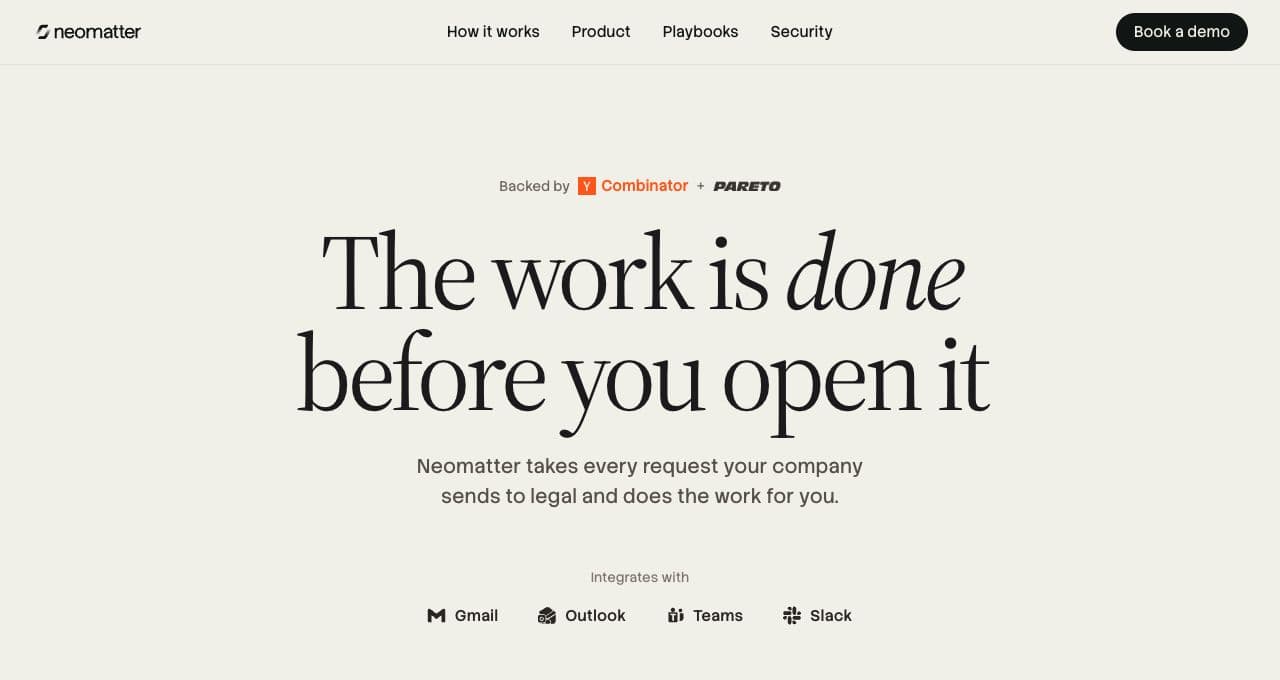
A legal request often arrives with only part of the context: a message from sales, a marked-up contract or a question in chat. Before counsel can decide, someone has to find the previous agreement, identify the company's position and work out which approval is actually needed.
Neomatter is building an operating system for that in-house workflow. It describes picking up requests from existing communication tools, gathering context, applying company playbooks and preparing analysis, redlines and replies for a lawyer's decision. The product's premise is to reduce the assembly work before review, while preserving the approval step. [1][3]
The founders and the in-house focus
Neomatter is a YC Fall 2026 company founded by Luke Wagner and Luke Mainwaring. The public launch describes conversations with more than two hundred in-house legal teams as part of the company's research. Their public profiles identify Wagner as CEO and Mainwaring as CTO. [2][3]
The audience is important. An in-house team's answer depends on the company's prior decisions, authority structure and commercial context, not just on generic contract language. Neomatter's public description puts those internal playbooks and precedents at the center of its preparation workflow. A buyer should evaluate how well the product preserves that context rather than simply how quickly it produces text. [1]
A matter has a state, an owner and evidence
The current website shows requests progressing through active, waiting and completed states. It describes reading the incoming material, checking playbooks and past deals, preparing a recommendation and returning the decision to the responsible lawyer. Source citations connect the proposed answer to supporting passages. [1]
For a legal operations leader, the useful unit is the complete matter. What information is missing, who owns the next decision and what was sent after approval? A draft answer can be polished while the matter remains blocked. We would therefore inspect the queue and handoff behavior as closely as the generated analysis.
A commercial contract with a policy exception
The website's commercial-contract examples show a proposed fallback alongside an escalation option. They illustrate using company positions and approval authority to prepare a decision, rather than asking the lawyer to search for every precedent from scratch. These are demonstration matters, not named customer transactions. [1]
A buyer can test the same pattern with historical agreements whose outcome is known. Ask the product to identify the relevant policy, locate the closest precedent and distinguish the normal fallback from an exception requiring another approver. Counsel should be able to inspect the underlying passage and revise the proposed reasoning. The product demonstration should not be taken as legal guidance for a different agreement.
Answering a familiar internal question
Neomatter also presents requests such as permission to use a logo or preparation of corporate paperwork. In those examples, the system assembles the context and a reply, while the reviewer determines whether the response is appropriate. The workflow is documented publicly; it does not establish that every category of legal work can be completed autonomously. [1][3]
Our read is that recurring questions are a useful first evaluation domain because the team can define the evidence and approval path. A successful answer should identify the right source and preserve any condition attached to it. If the precedent is missing or the request falls outside the playbook, the system should make that uncertainty visible rather than manufacture an apparently settled answer.
Following work that is waiting on someone else
The public interface includes matters waiting on another department's information or a counterparty's response. That acknowledges a large part of legal operations: knowing why work has stopped and what is needed to move it forward. The company describes maintaining that state across incoming requests and business systems. [1]
A team could evaluate this with a matter that changes over several messages. Does a new attachment update the correct request? Can the lawyer see which assumption is no longer current? We would also inspect how an approved answer is distinguished from a draft and how a completed matter preserves the final record.
Where Neomatter fits on SOTA2
| Product & task | Position | Comparison scope |
|---|---|---|
| NeomatterReview ContractsCross-industry | #4 | 10 companies · 13 candidates 8 ranked products |
What we would look for in a pilot
Start with one recurring matter type, a curated playbook and historical examples that include both routine answers and exceptions. Ask counsel to compare the prepared work with the original decision, including the cited sources and required authority. Measure preparation time, review time, missing context and the corrections required before approval. A fast draft that takes longer to verify is not a successful efficiency result.
For the COO or legal operations lead, follow a request across its communication channels and status changes. Confirm access boundaries, the treatment of privileged information and the action that sends an approved response. Test a withdrawn approval and a superseded document so the team understands how the system handles changes in the matter.
For the CFO, compare implementation and subscription costs with preparation work, queue delays and outside-counsel spend for the selected scope. Keep those measures specific. The pilot should establish whether the team gets more usable work ready for decision, while counsel remains accountable for the judgment and the final communication.
The SOTA2 view
Neomatter is worth examining where an in-house team spends substantial time collecting context and preparing familiar work before exercising judgment. Its useful proposition is a matter that arrives with evidence, a draft and a clear decision to make. We would evaluate the completeness and traceability of that preparation, together with the queue and approval behavior.