
An agent handles a situation badly. An engineer reads the trace and patches the prompt. The next situation needs another exception, and the one after that another. [2]
Soon, improving the agent is a recurring engineering job, and the prompt keeps growing until a fix for one conversation changes all the others. [1][2]
Mirrors keeps each fix where it belongs.
It’s a runtime layer that turns what you see in your traces into guidance for a specific situation, and delivers that guidance mid-conversation when the situation comes up again. There’s no redeploy and no code change. [1][2][3]
Instead of one ever-growing prompt, the agent gets the right context at the right moment. [1]
From trace to fix in minutes
Teams review their agent’s sessions alongside their outcome labels and feedback, and decide where a change in context could help. Mirrors also finds patterns across past runs. [1][2]
They write the guidance the agent needs and preview every session it would match, including unexpected ones, before anything goes live. [1][4]
When a matching situation comes up, Mirrors delivers the context while the agent works. Teams can also adjust tool descriptions, schemas and the results the model sees. [1]
Then they compare sessions with and without the change, using the outcomes they already track, and keep what works. [1]
The application stays in charge of its agent, including its tools, streaming and model calls. Mirrors supplies context before each model call, and when nothing matches, the agent runs on its original prompt. Teams can run it in shadow mode first. [3]
It works with the stacks teams already use, including LangChain, LangGraph, LlamaIndex, CrewAI, Pydantic AI, Google ADK, the OpenAI and Anthropic SDKs and MCP. [1]
Built by a researcher who started publishing in high school
Aryan Singhal published four AI and machine learning research papers while still in high school, at conferences including NeurIPS and EMNLP, and has done ML research at UT Austin and UC Santa Barbara. [2]
Mirrors is based in San Francisco and is part of Y Combinator’s Fall 2026 batch. [2]
How a team would use it
Here’s how a team running customer-facing agents would use it.
An agent stuck retrying a tool
A tool call fails, and the agent tries the same action again, and again, while the customer waits. [5]
A developer spots the pattern in the traces and writes guidance on when to stop retrying, what to try instead and when to bring in a person. Mirrors delivers it the next time an agent hits that situation. [1][5]
Before activating it, the team previews which past sessions would match, including ones where another attempt was the right call. Afterwards, it checks whether agents recover more often. [1][4]
A missed license check
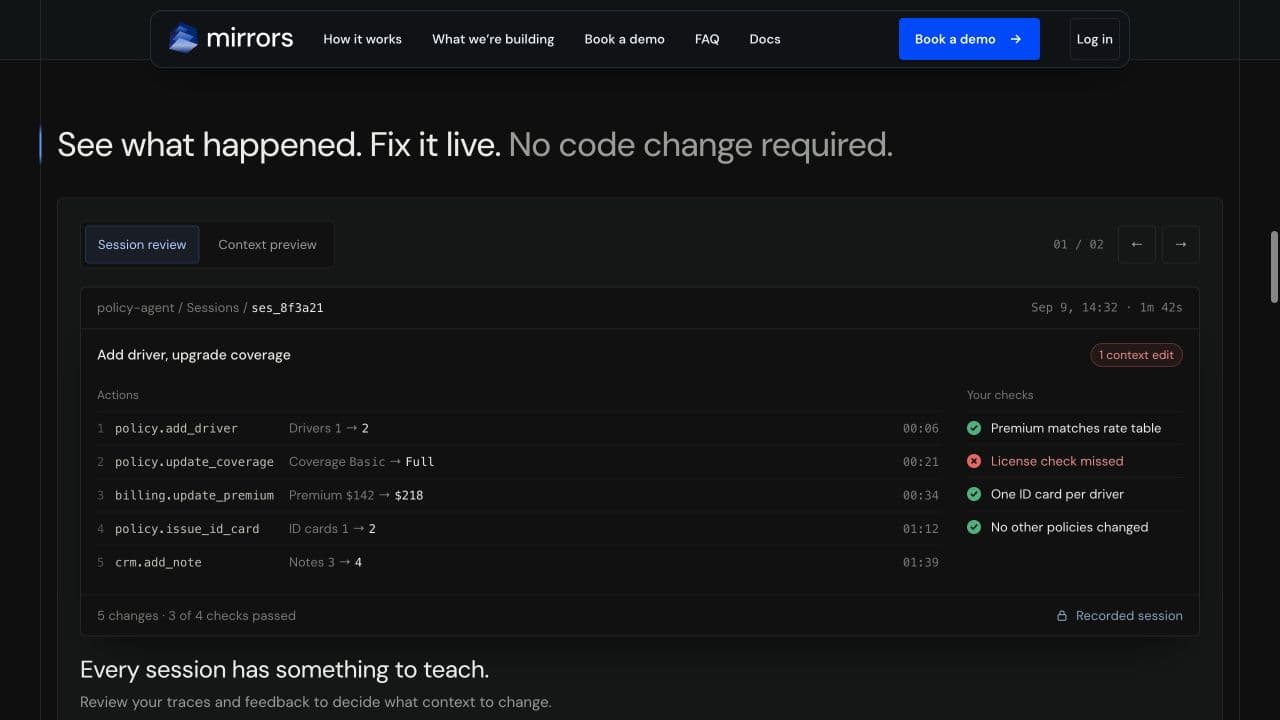
An insurance policy agent adds a driver, upgrades the coverage and updates the premium, but skips the license check. The session view shows the missed step next to the team’s own checks. [1]
A targeted reminder reaches the agent at that point in the next similar conversation, without changing how it handles a billing address or a cancellation. [1]
Where Mirrors ranks
A ranked comparison is not yet available for Mirrors.
The bigger picture
Agents in production meet a huge range of customer situations. [2]
Every bad session teaches something. Today those lessons stay buried in traces, or end up in a prompt that grows until nobody can change it safely. [1][2]
Mirrors is betting that agents improve fastest when each lesson is delivered only where it applies.
Fix the situation, not the whole prompt.
Written by SOTA2 from Mirrors’ public materials and information the company provided. Product plans are reported by Mirrors. Ranking analysis and comparison data are from SOTA2.
Sources
- Mirrors — the right context at the right time
- Y Combinator — Mirrors company and founder
- Mirrors documentation — capture and runtime responsibilities
- Mirrors documentation — reviewing and activating corrections
- Mirrors — tool-retry use case and product explanation supplied for this article by the company