
A distributor's buyer rarely needs another isolated forecast. They need to know which customers are waiting, what is already on order and whether a replenishment decision can be made with confidence. Those answers can be scattered across an ERP, email and the judgment of the person who usually knows the exceptions.
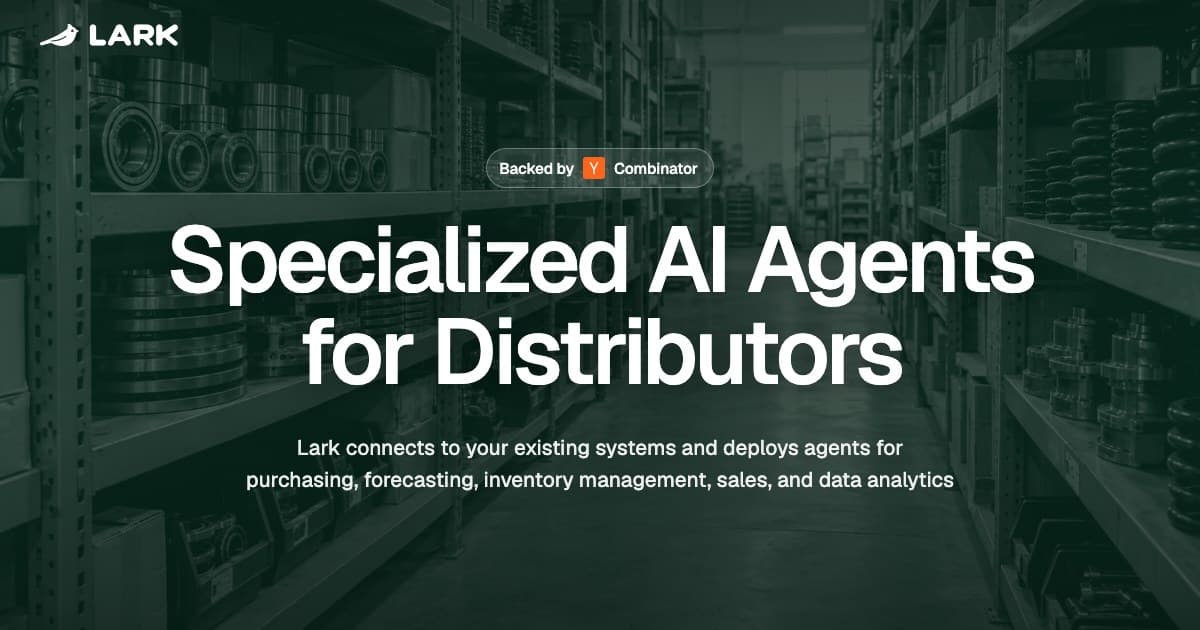
Lark deploys specialized AI agents for wholesale distributors, working on purchasing, demand forecasting, inventory monitoring, sales operations and data analysis. Its current website shows those jobs as connected workflows: a demand change informs a recommendation, which becomes a purchase order inside an approved process. [1]
The distributor-focused Lark
Lark was founded by Jason Wang and Michael Wang and is in YC's Fall 2026 batch. Its public company description focuses on wholesale distribution and working with existing ERP systems. [2]
Jason Wang's public profile describes industrial supply-chain agent work and engineering at Confluent. The product's focus is correspondingly operational: learn from a distributor's records and team decisions, then help perform the recurring work around them. The claim that agents can cover more of an operation should be evaluated workflow by workflow. [2]
From a recommendation to an approved action
The public purchasing demonstration ranks work by customer commitments and stock availability, prepares orders by vendor and describes writing into the ERP within approved limits. Larger or otherwise exceptional work waits for a buyer. The website also says users can pause or take over the workflow and inspect logged actions. [1]
The sample distributor, vendors, quantities and thresholds shown in that interface are demonstration data. They illustrate a control pattern rather than establish a customer outcome. A buyer should set the limits appropriate to its own operation and verify that the agent consistently observes them, including when source records disagree.
Replenishment when customers are already waiting
Lark's purchasing scenario brings backorders, available stock and expected replenishment into one worklist. It describes preparing purchase orders and vendor emails while preserving a buyer-review path. This gives a concrete starting point for evaluating the product on a distributor's own items. [1]
We would follow an urgent line from the underlying demand through the suggested quantity and resulting order. Does an open purchase order already cover the need? Is the vendor appropriate, and is the lead time current? The useful result is an order that should actually be placed, with an explanation the buyer can inspect, rather than a high volume of automatically created documents.
Demand shifts and inventory exceptions
The forecasting and inventory demonstrations connect recent sales history with replenishment. The site shows comparisons across time windows, explanations of a demand shift and exceptions such as mismatched on-order records or excess stock. These are documented scenarios, not a published forecast-accuracy benchmark. [1]
For an operations leader, the relationship between the forecast and the action matters. A temporary spike, a single large order and a sustained change can call for different responses. We would ask Lark to show the evidence behind a recommendation and let the buyer change an assumption. The organization should be able to explain why inventory moved, not just point to an agent's answer.
Keeping the commercial team in the loop
Lark also describes matching sales email to deals, updating CRM stages and flagging stalled opportunities, alongside plain-language analysis grounded in existing records. Those tools could help a distributor keep a shared picture of demand and customer commitments as work moves between sales and purchasing. [1]
A useful evaluation would trace one changed customer request through both sides of that handoff. Which system is authoritative, how are ambiguous messages handled and who reviews a disagreement? We would not infer that a successful email classification proves end-to-end order correctness. The buyer's test should follow the downstream record and the decision it triggers.
Where Lark fits on SOTA2
| Product & task | Position | Comparison scope |
|---|---|---|
| Lark PlatformForecast DemandLogistics & Supply Chain | #5 | 10 companies · 11 candidates 9 ranked products |
What we would look for in a pilot
Begin with a small item set and one purchasing workflow. Reconcile the historical sales, stock, open orders and supplier rules with the team before asking an agent to act. Run representative cases, including an apparent shortage already covered by an incoming order and a demand spike the buyer would not automatically extrapolate. Compare recommendations and actions with that baseline.
For the COO, inspect workflow limits, action logs, pause behavior and the response to a failed ERP update. Record how many items still need investigation and whether the explanation reduces that effort. Forecasts should be judged against subsequent demand using an agreed method, while purchasing should be judged by the quality of the resulting decisions.
For the CFO, separate lower administrative effort from inventory and service improvements. Include onboarding, data mapping, service fees and continuing buyer review. A change in working capital needs a baseline and enough time to distinguish an agent's effect from seasonality or a change in the product mix.
The SOTA2 view
Lark is worth examining when a distributor already has the essential records but still coordinates purchasing and inventory work by hand. Its useful connection is from those records to an explained recommendation and a bounded action in the existing system. We would start with the buyer’s worklist, then expand after the team can see how the agent handles uncertainty.