
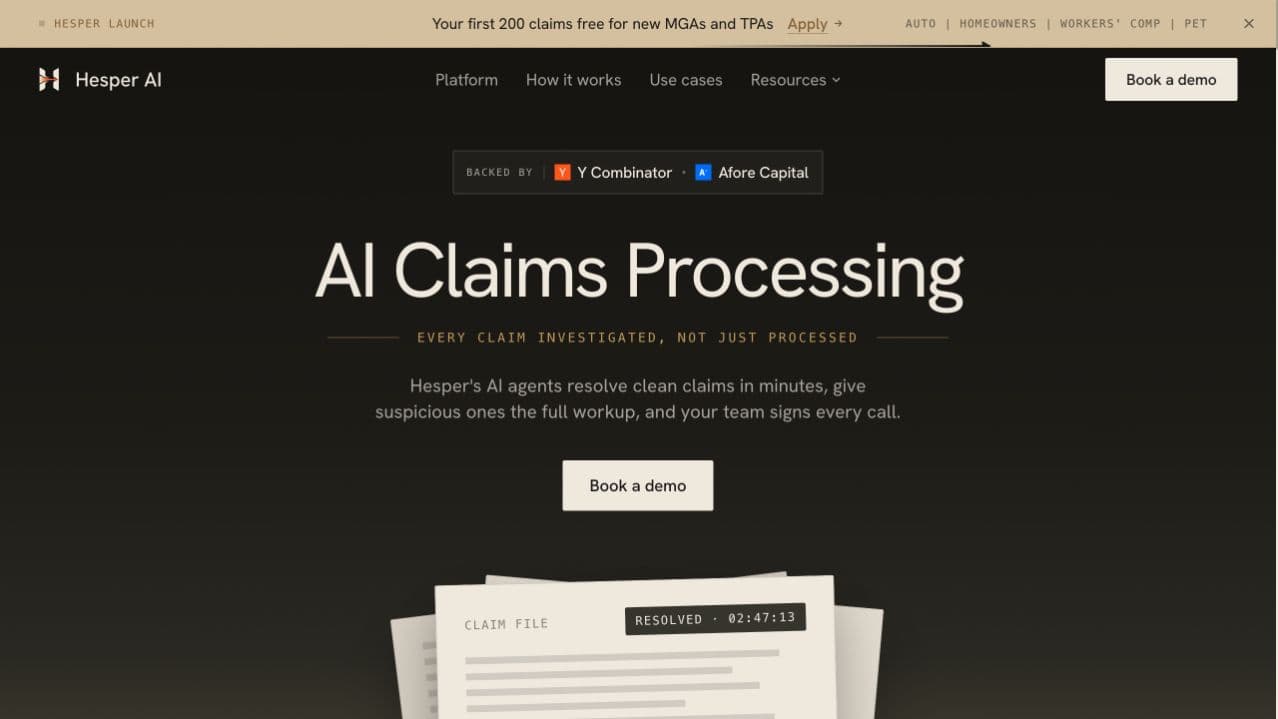
A claim arrives as a collection of forms, statements, photographs and supporting records. Someone has to establish what happened, find missing information, check the evidence and move the file to the next person. Even when each task has software support, the handoffs can leave an adjuster rebuilding the same picture several times.
Hesper AI is building a platform for work across the property-and-casualty claims lifecycle. It describes supporting intake, triage, investigation, settlement-related work and recovery, with people retaining oversight of claims decisions. The target organizations include insurers, third-party administrators and managing general agents. [1]
From document automation to claims operations
Hesper AI joined YC’s Fall 2026 batch. Founders Pankaj Dhariwal and Nitish Badu previously worked at Nanonets, giving the team experience with document-intensive operational workflows. Their public YC description centers on connecting claims work that would otherwise move between systems and teams. [2]
The product’s relevance is easiest to understand at the file level. An intake summary becomes more useful if the investigator can inspect its supporting evidence, and an investigation becomes more useful if the findings reach the person responsible for resolution. The business problem is the continuity of that work.
A file that moves from intake to investigation
Hesper’s published workflow describes extracting information, identifying what is missing and carrying an evidence trail into investigation. The system assembles relevant material and produces a report and recommendation for review. Its investigation description covers multiple phases, rather than treating a single document extraction as the completed claim. [3]
For a claims manager, that offers a way to organize the work around the unresolved questions in a file. An incomplete incident account may need a document request; a contradiction may need investigation; a finished report may need an adjuster’s decision. The workflow needs to preserve which of those states the claim is actually in.
The homepage illustrates a fast-moving resolved file and makes claims about processing speed. Those illustrations are useful for explaining the intended experience. They should not be read as evidence that every claim can be settled in minutes or that complex judgment has disappeared. [1]
Give investigators an evidence package they can examine
Hesper’s fraud-investigation page describes gathering documents and statements, reconstructing a timeline and identifying inconsistencies or connections for a special investigations unit. The platform can work alongside an existing fraud-detection system or provide an investigation workflow of its own. Findings are presented with citations to the underlying evidence. [4]
The page’s illustrative auto-claim scenario shows the intended handoff: organize the information that may justify further investigation, then let a person examine the case. An inconsistency is a reason to investigate, not proof of fraud. Hesper describes human review for conclusions, referrals and claim decisions. [4]
This can matter even when an investigation produces no adverse finding. A well-organized explanation of the evidence helps the next reviewer understand why a case was cleared or what remains uncertain. The quality of that record is more useful to assess than the number of items a system flags.
Carry the same evidence into recovery work
Subrogation asks whether another responsible party may owe some of the money paid on a claim. Hesper’s recovery page describes screening files for potential third-party liability, assessing the available evidence and preparing materials for a recovery team. It includes comparable preparation for demand or arbitration packages; the team decides what to pursue. [5]
Its property example brings together contractor information, invoices, photographs and statements around water damage. The example is illustrative, rather than a named customer case or a reported recovery result. It shows how evidence already present in the claim can support a second workflow after the initial loss has been handled. [5]
The operational connection is important: recovery should be able to use a documented investigation without reconstructing the file from scratch. At the same time, a potential recovery needs an owner, a reviewed rationale and a clear decision to proceed. Packaging evidence is only part of that responsibility.
Where Hesper AI fits on SOTA2
| Product & task | Position | Comparison scope |
|---|---|---|
| Hesper AI PlatformOrchestrate WorkflowsFinancial Services & Insurance | #2 | 37 companies · 48 candidates 10 ranked products |
| Hesper AI PlatformInvestigate CasesFinancial Services & Insurance | #10 | 17 companies · 25 candidates 10 ranked products |
What we would look for in a pilot
We would follow a sample of completed claims from intake through investigation and any recovery referral. Compare what the platform assembles with the existing file, including omitted evidence and unresolved contradictions. Have adjusters and investigators assess whether the citations support the conclusions and whether they can find the original material quickly.
Measure handoff time, repeat document requests and review effort alongside the quality of the final file. Keep decisions about coverage, suspected fraud and recovery with designated staff. Confirm which system owns the claim state and how an approved finding returns to it.
The SOTA2 view
Hesper AI is relevant to claims organizations whose main friction lies between tasks and teams. Its strongest proposition is connecting the evidence gathered early in a file with the investigation and recovery work that follows. A useful deployment should make that continuity visible to the people accountable for the claim.