
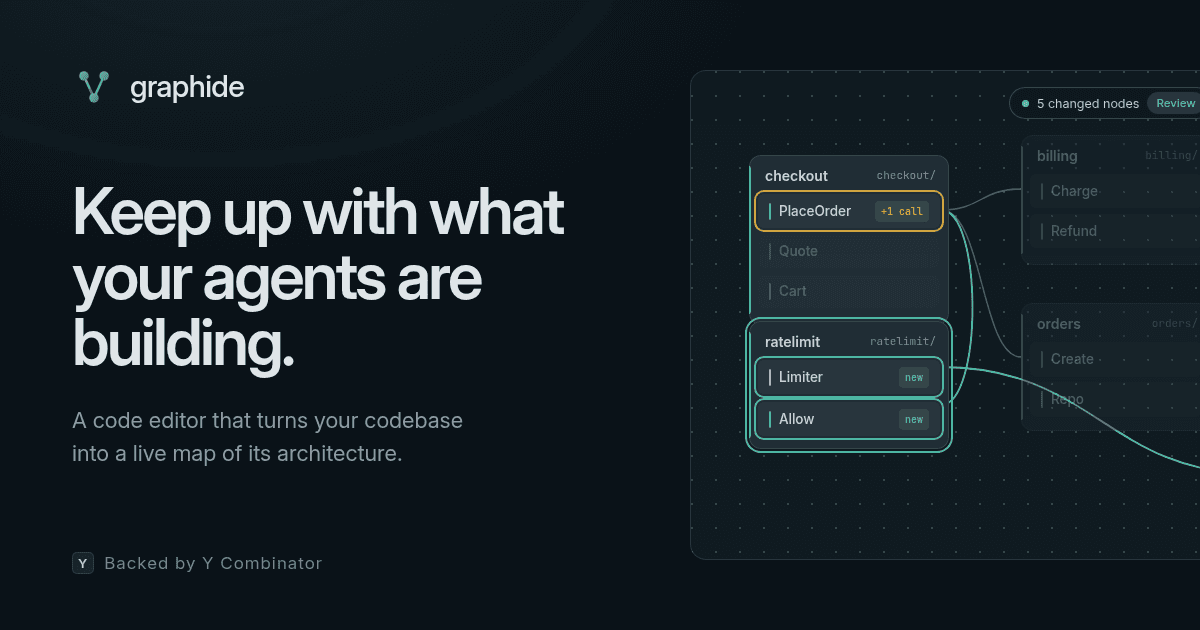
A coding agent can change enough files that understanding the result becomes the slow part. A diff records the individual edits, but a reviewer still has to reconstruct the system: which path now handles a request, what depends on it and whether an unexpected area was touched.
Graphide approaches that problem with a code editor and a live architecture graph. Its public website describes mapping modules, classes, functions and their connections, then showing agent changes in that context. The intended benefit is orientation before detailed review: a developer can identify the affected area and ask a more focused question about the code. [1]
The team behind the map
Graphide is a YC Fall 2026 company co-founded by Dan McGee and Benjamin McIntyre. McGee's public profile describes software automation work and policy-simulation systems at Illumio. McIntyre's describes technical operations and a university Linux and open-source community. These are relevant backgrounds for a tool that has to connect a system model with working software. [2]
The company's public positioning is specific about its audience: developers whose agents produce changes faster than they can comfortably read them. That does not make code review obsolete. It changes where a reviewer starts, from reconstructing the design by hand toward checking a visible model against the actual implementation. [1][2]
From repository to a navigable graph
The current website presents a public repository-mapping experience as well as the downloadable editor. The graph contains symbols, descriptions and relationships, and can be versioned with the repository. Graphide also describes an MCP interface through which compatible agents can search and modify the graph. [1]
A separate check compares parts of that graph with the code: whether symbols and routes are declared as expected and whether marked critical edges remain present. This is an architectural consistency check as described by the company. It should not be confused with proof that every business rule or runtime behavior is correct. A useful demonstration would show both the graph finding a discrepancy and the underlying code that explains it. [1]
Understanding an unfamiliar codebase
The first documented scenario is opening a repository and asking how it works. Graphide's public demonstration uses open-source projects to show a map from larger modules down to symbols and relationships. That can give a new contributor or technical lead a starting point for a discussion about responsibilities and dependencies. [1]
The practical evaluation is whether the map makes the next question easier to answer. Choose a real path through your application, then ask a developer who knows it to review the generated representation. Missing relationships, misleading descriptions and generated-code noise are useful findings. A visually coherent map becomes valuable when the team can identify how it corresponds to the repository.
Steering a change before it spreads
Graphide describes planning through nodes and edges while coding agents implement the work. The website shows the agent's activity on the same graph, allowing a developer to see which components are being touched. This is a documented product scenario, not a published customer case with a measured delivery-time result. [1]
Consider a feature intended to affect one workflow. The team can use the map to name the expected modules and inspect changes outside that area. The human still decides whether an architectural change is justified. Our read is that the map is most useful as a shared planning surface: it makes the intended scope explicit enough that deviations can be discussed while the work is happening.
Reviewing changes across file boundaries
The site's diff-versus-graph demonstration emphasizes an unexpected authentication change inside a larger patch. The example is illustrative. Its useful point is that a small edit in a sensitive dependency can be hard to notice when it is buried in many changed lines. [1]
A review process could therefore use the graph to select the areas needing closer inspection, then return to the code, tests and runtime evidence. We would also check what happens when two agents work at once, how stale graph information is surfaced and how a reviewer sees the difference between an inferred relationship and an explicitly maintained design decision.
Where Graphide fits on SOTA2
A ranked comparison is not yet available for Graphide.
What we would look for in a pilot
Begin with a repository the team understands and one recent change whose intended scope is known. Compare the generated graph with an engineer's explanation of the same request path. Then introduce a small, controlled change across a dependency boundary and inspect how Graphide updates its model. Measure orientation and review effort, but also the errors or omissions that require manual correction.
For the engineering lead or COO, the operational question is whether the graph helps the team detect drift and coordinate agent work without creating another artifact to maintain by hand. Evaluate sync behavior, merge conflicts and how graph checks fit the release process. Keep the code-level tests that verify behavior; architecture visibility and behavioral correctness supply different evidence.
For the CFO, consider licensing, onboarding and the time spent maintaining the representation against review and coordination work saved. Do not extrapolate from the size of a visual graph to an ROI estimate. The useful result is a repeatable improvement on a set of representative changes.
The SOTA2 view
Graphide is worth examining when the volume of agent-written code is making system understanding a constraint. Its clearest idea is to keep the architecture, the agent’s activity and the repository in the same conversation. A buyer should judge whether that representation remains accurate enough to guide decisions as the code changes, then use it to focus the existing review process.