
A production plan is only useful if the surrounding work follows it. Materials must be available, an engineering revision must reach the right team and the business system needs to reflect what actually happened. When those steps live in separate applications, people become the coordination layer.
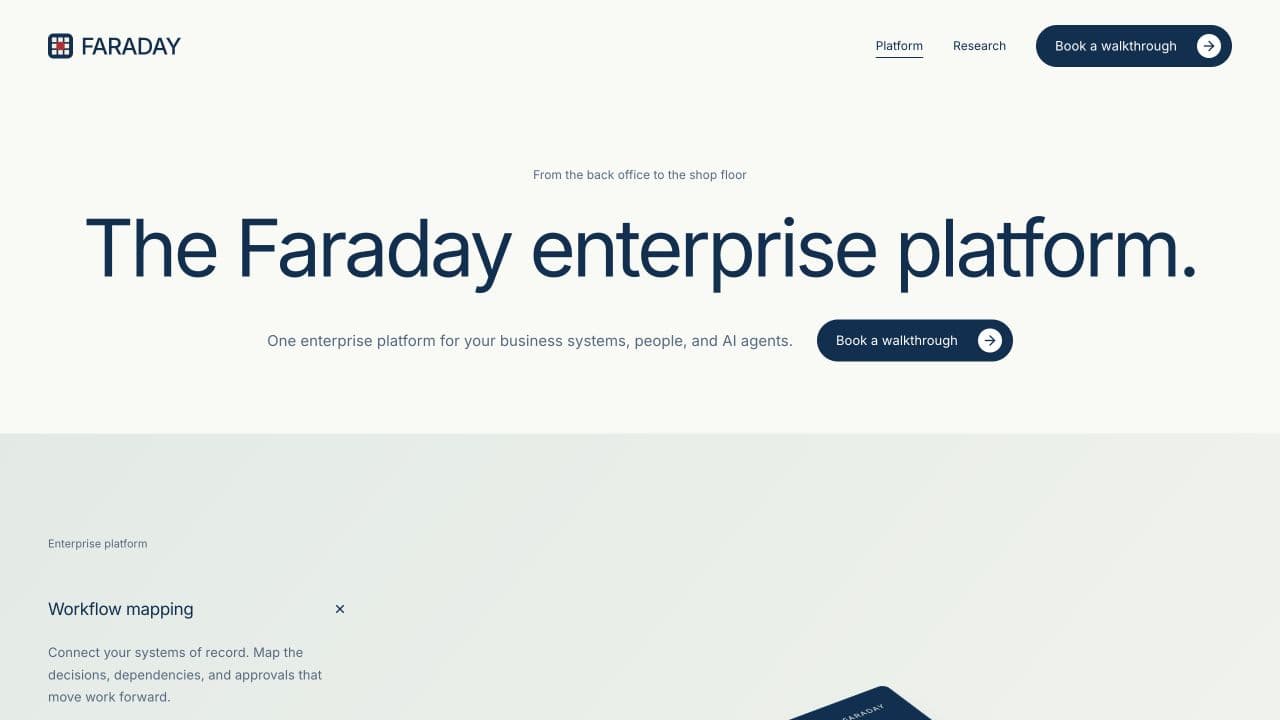
Faraday is building an industrial AI platform around that coordination work. It describes a shared runtime connecting agents, existing enterprise systems and, increasingly, physical equipment. The aim is to carry a process from analysis through execution and record updates, with the operation's constraints and approval rules built into the workflow. [1][2]
A team with industrial and software experience
Faraday is a YC Fall 2026 company founded by Datta Kaligotla and Oscar Rangel. Their public profiles describe engineering experience across enterprise software, aerospace, factories and medical devices. The company's introduction connects that background with work spanning the back office and shop floor. [2]
The relevant product question is how those worlds stay aligned. A recommendation in a dashboard can be separated from the person who changes a schedule or releases an order. Faraday's public positioning treats those handoffs as part of the platform's responsibility, making execution and traceability important topics for a buyer's demonstration. [1]
A runtime shaped around the operation
Faraday describes combining operating procedures, enterprise data and expert feedback, with customer-specific environments used to improve how agents execute multi-step tasks. Its current website organizes the platform around models, harnesses, data, applications and robotics. These are components of the company's approach, not proof that every advertised workflow is equally mature at every customer. [1][2]
For a COO, the useful unit is one completed process. Which records does the agent read, what may it change and where does a person approve an exception? A focused walkthrough can follow those actions across the existing systems. That is more informative than treating a long list of industrial use cases as one undifferentiated capability.
Replanning production around a real constraint
Production scheduling is a documented scenario. Faraday's website describes aligning jobs with machines, materials and people, then comparing changes with delivery commitments before releasing a new plan. It also describes coordinating follow-up when constraints change. [1]
A plant could evaluate this on a historical scheduling disruption: one machine unavailable, a late material or a changed priority. We would ask the team to show which jobs move, which promises are affected and how the revised decision reaches the floor. This is a proposed pilot scenario based on the documented workflow; the available source does not provide a named customer's measured improvement for it.
Inventory and order entry across fragmented records
Faraday also presents inventory management and order entry. The first brings shortages, stock and commitments into an operating view; the second turns customer requests into structured orders and flags missing or inconsistent information before fulfillment. [1]
Those scenarios meet at a practical handoff. An incoming order should not become a promise based on an outdated stock record. A buyer can follow one request from its source document through validation, exception review and the resulting business-system entry. We would inspect how the system handles an unknown part or conflicting delivery information, since those cases reveal whether it reduces coordination work or simply moves it to another queue.
Engineering changes and financial handoffs
The public site includes engineering review, quoting and accounts payable among its workflows. It describes carrying requirements through drawing and bill-of-material checks, and matching invoices against purchase orders and receipts. These are documented use cases, rather than published customer outcomes with a common performance baseline. [1]
The useful connection is control of the underlying state. A changed bill of materials can affect purchasing, cost and the production plan. An invoice discrepancy can require evidence from receiving. We would ask Faraday to demonstrate the version and source used at each step, how an approval is recorded and what happens if one downstream system is unavailable. The owner of the process needs to be able to reconstruct the decision.
Where Faraday fits on SOTA2
| Product & task | Position | Comparison scope |
|---|---|---|
| Faraday enterprise platformOrchestrate WorkflowsManufacturing & Industrial | #10 | 14 companies · 16 candidates 10 ranked products |
What we would look for in a pilot
Choose one bounded workflow with a known volume and clear completion criteria. Map the current systems and manual handoffs, then run representative historical cases, including exceptions. Measure accepted output, manual touches, elapsed time and corrections after the record is written. Keep the system's recommendation separate from the operational action it actually completes.
For the COO, require a demonstration of approval limits, failed integrations and recovery. If equipment is involved, identify the boundary between business-system coordination and machine control. Start with the portion of the workflow whose behavior can be observed and reversed, then expand only after the people running it understand the handoffs.
For the CFO, compare deployment and service costs with the time and working capital tied up in that specific process. Include data preparation, ongoing rule maintenance and the staff who handle exceptions. Avoid combining several possible gains into one ROI claim before the pilot establishes which changes actually occurred.
The SOTA2 view
Faraday is relevant where industrial work is slowed by the gaps between planning, enterprise records and execution. Its proposition is broader than a single recommendation engine, so the strongest evaluation is deliberately narrow: one process, visible actions and an accountable owner. A successful pilot should show that the work and the business record stay aligned when the normal path breaks.