
A feature can be implemented correctly at the code level and still fail when a person tries to use it. The next button may be unreachable, a booking can stop before confirmation or a flow may work only for the account the developer used. Reviewing the patch does not answer every question about the experience.
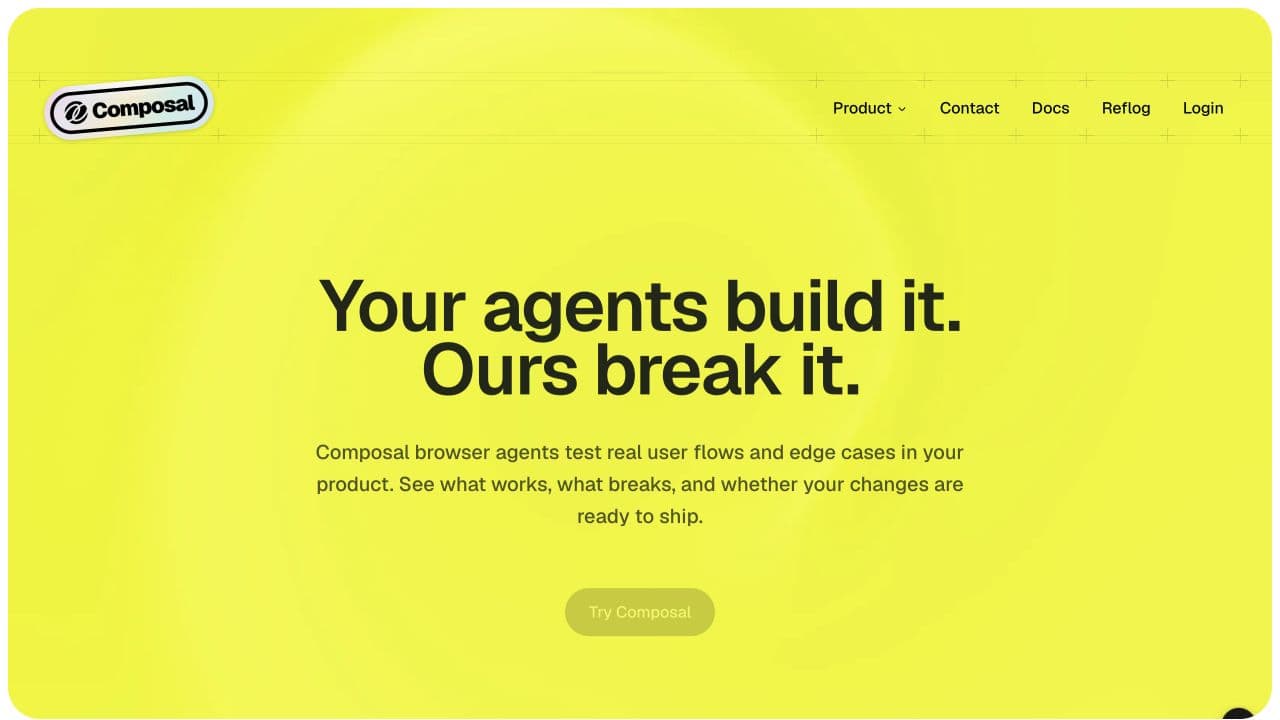
Composal sends browser agents through the product to examine real user flows and edge cases. Its public materials connect a URL and sources of product intent with parallel exploration, then return evidence of what worked and what broke. The focus is on the behavior a user can complete. [1][2]
Builders who have worked on coding agents
Composal is a YC Fall 2026 company founded by Pandelis Zembashis, Jonathan Davies and Jan Moehlmann. Their public profiles describe experience in coding-agent infrastructure, software engineering and commercial work at companies including Cosine, PapayaDash and other enterprise AI businesses. [2]
Zembashis's profile is particularly relevant to the problem: generating code and verifying the product it creates are connected but distinct tasks. Composal's positioning makes that boundary explicit. The testing agent uses the product, while the engineer or coding agent receives the resulting failure evidence and decides how to change the implementation. [1][2]
Product intent gives exploration a direction
The current website begins with a product URL and context from repositories, specifications and other connected sources. It then describes a swarm exploring the product and testing key flows in parallel. The output includes video, logs and reproduction steps. [1]
For a product leader, context matters because reaching a screen is different from accomplishing a feature's purpose. The team needs to express who the user is, what they should be able to do and which outcomes count as success. Browser exploration becomes more useful when it can relate a failed interaction to that intent, rather than returning a collection of surprising screens without a clear priority.
Booking and checkout flows
Composal's public demonstration uses an activity-booking experience with dates, guests and payment. It shows a scenario that cannot complete the booking and an associated sequence of steps. This is an illustrative product example, not a testimonial from a customer running that business. [1]
A buyer can adapt the scenario to a real release: select an available option, enter the required information and verify that confirmation exists in the expected place. The reviewer should be able to watch the failure and distinguish a product problem from an unavailable test dependency or deliberately restricted account. That makes the evidence actionable for the engineer receiving it.
Testing beyond the happy path
The website describes agents exploring edge cases alongside critical flows. An operations team could evaluate that by supplying a known boundary: an unavailable slot, a repeated submission or a user with a different permission level. These are suggested pilot designs, rather than claims that Composal has independently validated every such condition. [1]
The owner still needs to decide which edge cases matter. A rare cosmetic problem and a flow that prevents a user from completing the core task should not arrive as equal-priority work. We would ask how the findings are grouped, whether the expected outcome is visible and how a reviewer rejects an incorrect report without losing the useful evidence.
Sending the failure back to the builder
Composal's public workflow ends by passing reproduction steps to a coding agent. That is the practical connection between finding a problem and reducing the work needed to fix it. The agent receives a description of the observed behavior, while the team retains responsibility for accepting the patch and verifying the result. [1]
We would look closely at the second run. Does the original flow now complete, and did the change disturb another important path? A useful test artifact should survive long enough to answer that question. The public material establishes the intended workflow, but does not provide a named customer outcome with a comparable before-and-after release measure; a pilot should supply that evidence for the buyer's product.
Where Composal fits on SOTA2
| Product & task | Position | Comparison scope |
|---|---|---|
| CLITest SoftwareAgent | #6 | 6 companies · 8 candidates 6 ranked products |
What we would look for in a pilot
Begin with a staging environment, dedicated test accounts and three important flows with written success criteria. Include one known failure and one recently changed feature. Ask Composal to return a recording, relevant logs and steps that a developer can reproduce. Track false reports, missing context and the time from discovery to an accepted fix.
For the COO or product leader, the operating question is whether the findings help prioritize release work. Review permissions, test-data setup and any actions that must be disabled in staging. Assign a person to adjudicate ambiguous behavior so the testing system learns from a clear product decision rather than from an accidental environment limitation.
For the CFO, compare tool and setup cost with manual release testing and repeated engineering investigation. Measure the complete cycle through verification of the fix. A large number of agent sessions is useful only if it reduces the work needed to establish that the product's important flows actually work.
The SOTA2 view
Composal is relevant when teams can build features faster than they can check the resulting experience. Its clearest value is to connect product intent with evidence from using the interface, then carry that evidence back to the builder. We would judge the quality and reproducibility of its reports, and the speed of the verified fix, rather than the breadth of exploration alone.