
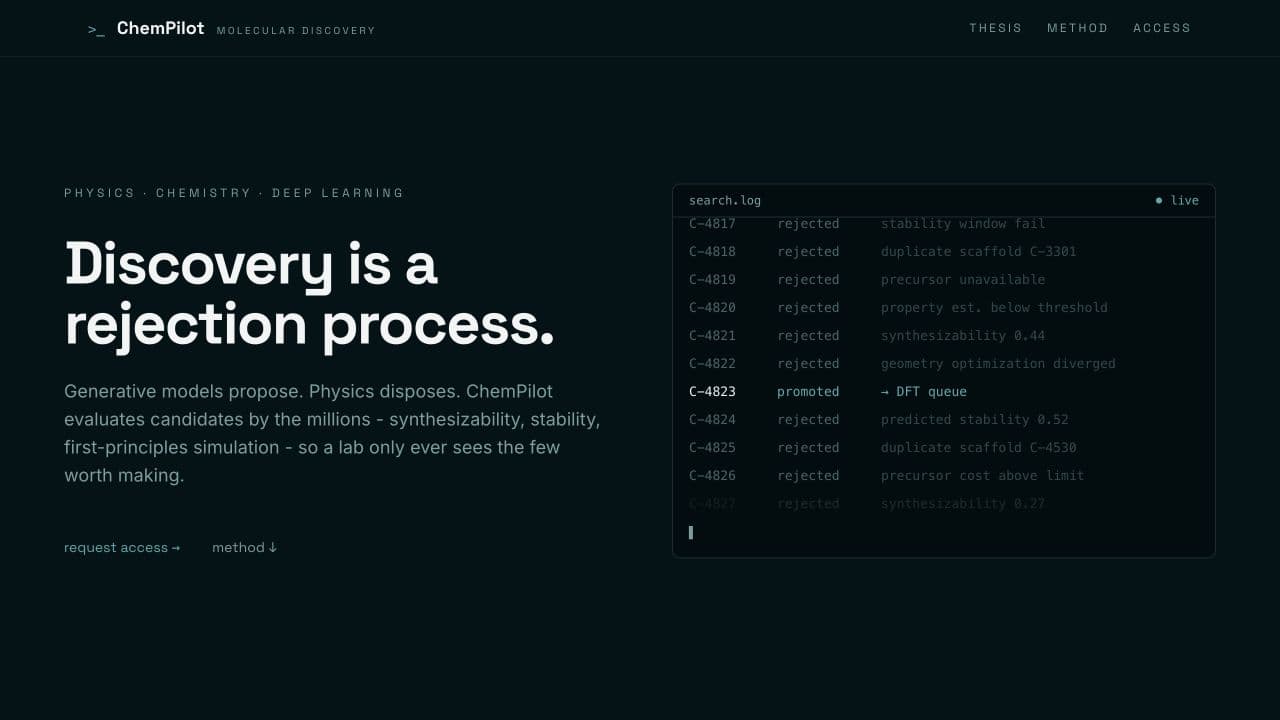
A research team can imagine many candidate materials and still have resources to make and test only a few. The constraint is not simply generating another possibility. It is identifying which candidates are plausible enough, and practical enough, to justify scarce experimental time.
ChemPilot.ai combines generative models with computational chemistry and physics-based screening. Its public website emphasizes rejecting candidates that fail relevant checks before sending a smaller set toward laboratory work. The proposition is a better-directed research pipeline, not a claim that a simulation alone establishes a material's performance in the world. [1]
A team spanning chemistry and software
ChemPilot is a YC Fall 2026 company founded by Sam Cogan, Ofir Simhi and Maor Goldman. The public YC profile connects the company to research at the Technion and to CSO Alon Grinberg Dana. The founders' backgrounds span biochemical engineering, software and computing. [2]
That combination is relevant to a workflow that must connect model outputs with scientific constraints. A candidate can look attractive to a predictive model while remaining difficult to synthesize, insufficiently stable or unsuitable for the intended process. The company describes bringing those considerations into the screening loop. [1][2]
Screening is a sequence of decisions
The public website lists synthesizability assessment, quantum chemistry, molecular dynamics and generative deep learning among its methods, together with compute used for simulation. It emphasizes specialized domains where the available empirical data can be limited. These describe the company's approach, rather than a reproducible performance benchmark provided in the reviewed public material. [1]
For an R&D leader, the useful question is how each check changes the candidate set. Which constraint is directly modeled, which is estimated from data and which still requires an experiment? A demonstration should make those distinctions visible. A model's ranking and the decision to commit laboratory resources are connected steps with different evidence requirements.
Prioritizing a materials program
ChemPilot's public company description focuses on defense and dual-use materials, including polymers, coatings, carbon fibers and composites. A team in one of those areas can use computational screening to narrow a research search before selecting candidates for experimental evaluation. [2]
A useful buyer conversation would begin with a target property, known constraints and the evidence already available for the program. It should end with a clear account of what the computational result does and does not establish. We would not present a newly proposed candidate as a validated substitute merely because it appears at the top of a generated list.
Working where the data is limited
The current website explicitly focuses on domains with relatively small datasets. That is a relevant distinction for industrial materials research, where a team may have valuable specialist observations without the volume of standardized data associated with a general-purpose model. [1]
A pilot could examine how the workflow uses the team's existing evidence and how it expresses uncertainty outside that evidence. Ask for a comparison on historical examples and on cases the model should reject. The evaluation should include unsuccessful predictions and the reasoning behind them, rather than only a selected set of attractive candidates.
Choosing what deserves the next experiment
The company's broader proposition is that computational work can help direct the next expensive laboratory action. It describes synthesizability and predicted performance being considered together, rather than treating novelty alone as a useful outcome. The public material does not provide a named customer study with a fully specified experimental baseline. [1][2]
Our read is that the practical deliverable should be a decision package: candidate priorities, the basis for those priorities, uncertainty and the experimental questions that remain. The laboratory team should be able to challenge an assumption and see how the recommendation changes. That makes the software part of the research process without turning computational confidence into an unsupported claim of real-world validation.
Where ChemPilot.ai fits on SOTA2
A ranked comparison is not yet available for ChemPilot.ai.
What we would look for in a pilot
Begin with a well-characterized historical materials problem for which the research team has both computational inputs and experimental outcomes. Agree on the target, exclusion criteria and evaluation method before running the workflow. Compare candidate ordering, rejected cases and uncertainty with that reference. Keep any new experimental work under the laboratory's established review and procedures.
For the R&D or operating leader, examine how data is prepared, how model and simulation versions are recorded and what information accompanies a proposed candidate. Ask how failed experiments feed back into the process. The useful operational measure is the quality of the next research decision and the work needed to make it, rather than the number of candidates generated.
For the CFO, distinguish compute and service costs from laboratory cost, program time and the expense of validating a new material. A shorter computational search does not by itself prove a shorter development program. The pilot should establish which decisions improve and which experimental stages remain necessary before estimating a broader economic effect.
The SOTA2 view
ChemPilot is worth examining when a specialist materials program has more plausible candidates than it can afford to test. Its useful idea is to combine generation with disciplined rejection and a clearer basis for the next experiment. We would judge the scientific traceability and retrospective validation of that workflow before extrapolating to development speed or commercial outcomes.