
A claim denial can reveal work that should have happened earlier: a missing note, an unsupported code or an authorization packet that did not contain the required evidence. By the time the problem reaches billing, several people may need to reopen the same record.
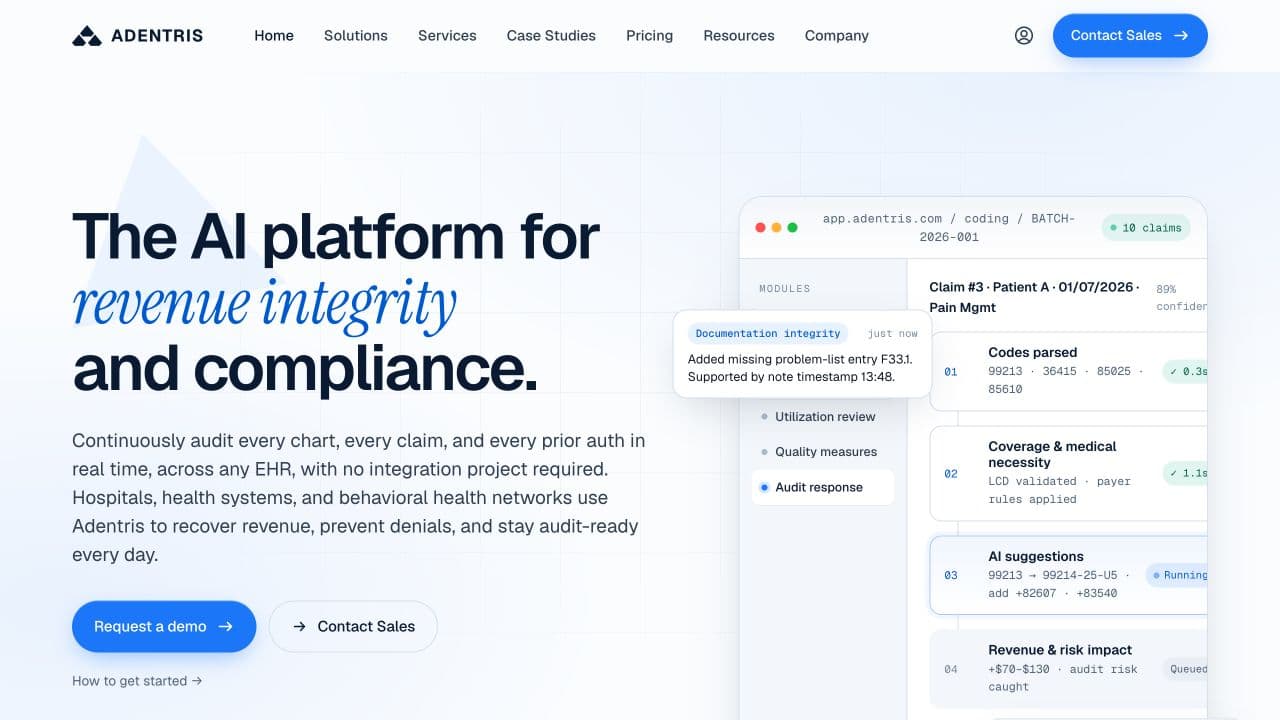
Adentris positions its platform around finding those gaps while the documentation and revenue workflow are still active. Its current public materials span documentation review, coding quality, prior authorization, denial response and discharge summaries, with findings routed to the people who can act on them. The product is aimed at hospitals, clinics and behavioral-health organizations working across existing systems. [1]
A team focused on healthcare operations
Adentris is a YC Spring 2025 company founded by Dmitry Karpov, Alex Odin and Sergey Yudovskiy. Their public profiles describe previous software, AI and business-building experience, including enterprise automation. The current YC description frames the company as a revenue-integrity platform rather than a replacement for the provider's clinical or billing team. [2]
That distinction matters to the operating model. A finding only helps when the responsible clinician, coder or reviewer can understand its basis and complete the required correction. We would therefore examine the route from source evidence to an accountable person, not merely the number of charts processed.
Working across existing interfaces
The public website describes several integration paths, including standard interfaces and a web agent that reads the EHR interface. It says the platform drafts documentation, suggests codes, checks readiness and routes findings with supporting context. The deployment path is specific to the provider's systems and should be demonstrated for the proposed environment. [1]
Browser-based access can change the integration project, but it also creates practical questions. What happens when the EHR layout changes, a session expires or a record is incomplete? A buyer should see how the platform detects those conditions and distinguishes missing evidence from a successful review. “No integration project” is not a substitute for that operational check.
Documentation gaps before submission
One documented scenario is checking a chart against the relevant program and payer requirements while care is still in progress. Adentris describes returning specific findings with the supporting rule or source, so the team can address a gap before it becomes a later revenue problem. [1]
A useful pilot would choose a defined document set and level of care, then compare findings with an established reviewer assessment. The goal is not to add more documentation indiscriminately. It is to identify what is genuinely missing or inconsistent and route that work to someone authorized to correct it. The platform's output needs to preserve the distinction between a suggestion and a signed clinical record.
Coding quality and the supporting chart
Adentris also presents autonomous coding and coding QA, including checks against the underlying documentation. The public interface illustrates suggestions and evidence for a coder to examine. The sample amounts and codes displayed on the homepage are not a measured revenue result for a named customer. [1]
For a revenue leader, the useful question is whether the proposed code or correction is supported and reproducible. We would review disagreement cases with experienced coders and track both accepted suggestions and inappropriate ones. More proposed revenue is not a complete quality measure: the organization must understand the documentation, review path and consequence of an incorrect recommendation.
Prior authorization and denial follow-up
The website describes preparing prior-authorization packets and supporting appeals and denial work. It also advertises services such as an accounts-receivable audit. These are different engagements: a recurring platform workflow and a focused diagnostic service should have separate scope, deliverables and measures. [1]
A provider evaluating these uses can follow a representative case from the payer request to the supporting evidence and the final staff-approved response. We would ask which steps the platform completes, which require a person and how a missed deadline or uncertain requirement is surfaced. Public customer stories can guide the discussion, but the provider's own evidence should determine whether the workflow is ready for wider use.
Where Adentris fits on SOTA2
| Product & task | Position | Comparison scope |
|---|---|---|
| Autonomous CodingAssign Medical CodesHealthcare & Life Sciences | #10 | 14 companies · 20 candidates 10 ranked products |
| AR Audit and RCM InsightsAnalyze DataHealthcare & Life Sciences | #10 | 28 companies · 30 candidates 10 ranked products |
What we would look for in a pilot
Start with one specialty or program and a de-identified historical set that has already been reviewed. Compare documentation and coding findings with that reference, including cases where the correct outcome is to make no change. Record accepted findings, missed issues, unnecessary work and how long a reviewer needs to verify the evidence. Expand to live work only when the team understands those results.
For the COO, inspect workflow ownership, integration recovery and the path from a finding to a corrected record. Have the people responsible for privacy, access and clinical documentation review the actual deployment and contractual controls. A product's security description supplies a starting point for that review; it does not replace verification of the organization's own configuration.
For the CFO, separate recovered cash, prevented rework and staff-time changes. Include deployment, human review and any additional billing services in the cost. Use an agreed baseline and an appropriate follow-up period before attributing changes in denials or collections to the platform.
The SOTA2 view
Adentris is relevant when healthcare revenue problems begin in the documentation and handoffs before submission. Its useful proposition is earlier, citable findings connected to corrective work. We would evaluate the accuracy of those findings and the quality of the review process first, then measure the effect on the specific revenue workflow the provider has chosen.